

ERP is no longer content with recording what already happened. Modern enterprises are pushing it to detect issues, recommend decisions, and execute workflows before delays, exceptions, or inefficiencies ripple across the business.
That shift is accelerating as AI moves from copilots to agents capable of reasoning across finance, supply chain, HR, and operations. Industry research shows that the majority of large organizations are already experimenting with AI agents, and ERP vendors are racing to embed autonomy directly into core business processes. The result is Agentic ERP: systems that don’t just inform work, but actively drive it, under clear governance and human oversight.
This blog examines the best agentic ERP solution providers for scalable, intelligent enterprises, cutting past marketing claims to evaluate who is delivering real, production-ready agents, and who is best positioned to support complex, global growth.
Key Highlights
An agentic ERP embeds AI agents directly into core business processes so the system can decide and act, not just report. These agents are software entities connected to live enterprise data and tools, capable of pursuing defined business goals with graduated levels of autonomy. As Capgemini describes it, AI agents operate within business environments to make decisions and execute actions while remaining governed by enterprise controls and human oversight.
Key capabilities define how effectively a solution delivers value, covering intelligence automation, integration, and scalability that directly impact business outcomes.
This transparency is essential for compliance, trust, and continuous improvement.

Not every ERP with an AI assistant qualifies as agentic. To separate real systems of action from surface-level copilots, we evaluate providers across the following criteria.
Together, these criteria form a practical, enterprise-grade lens for ranking the best agentic ERP solution providers, based not on vision slides but on deployable capability.

To simplify a crowded market, agentic ERP providers fall into three practical tiers, based on where agents operate and how broadly they can drive action.
These providers embed agents directly inside core ERP modules such as finance, procurement, supply chain, and HR. The agents are process-aware, policy-bound, and able to act across the full transaction lifecycle.
These solutions sit on top of or alongside ERP systems, acting as an orchestration layer that coordinates work across ERP and adjacent platforms (CRM, ITSM, procurement portals, analytics, etc.).
These platforms are built for industrial, asset-intensive, or service-heavy environments where operations are unpredictable, and exceptions are the norm. Agentic capabilities often appear as “digital workers” focused on operational execution.
This segmentation helps enterprises quickly align their needs, control, orchestration, or industry specialization with the right class of agentic ERP providers.
Below are the leading agentic ERP providers, based strictly on capabilities described on official vendor websites, product documentation, and press releases. Each profile highlights positioning, real agent use cases, and enterprise fit.
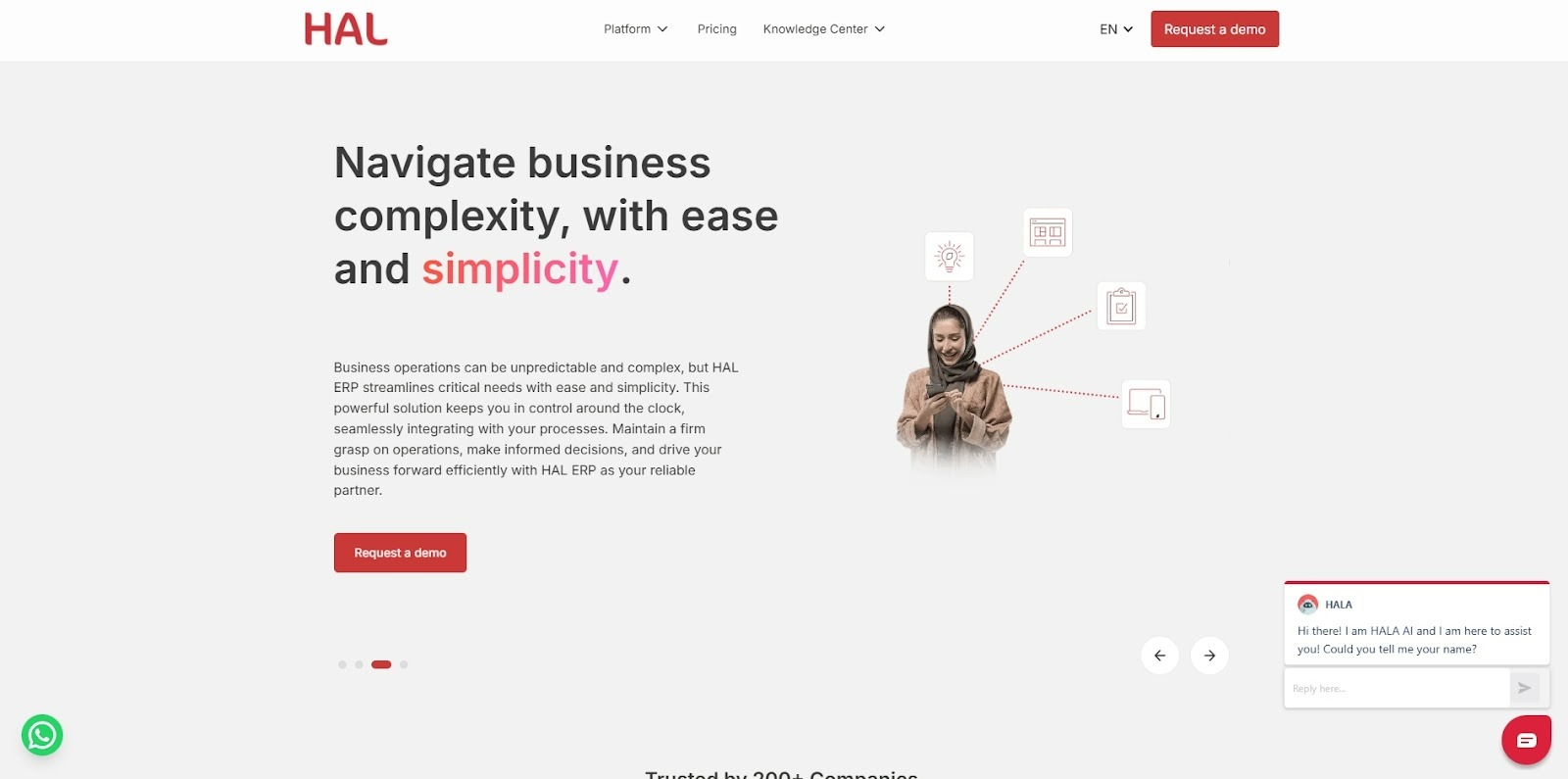
Agentic ERP augmentation for in-workflow execution
HAL acts as an agentic layer inside existing ERP workflows, enabling AI agents to detect exceptions, reason over live enterprise context, and guide or execute next-best actions without replacing core ERP systems.
Notable strengths
Enterprise relevance: HAL is best suited for organizations seeking fast, production-ready agentic capabilities without ERP replacement, particularly where exception handling, cross-team coordination, and time-to-value are primary drivers.

Business Suite + Joule Agents
SAP embeds role-based AI agents (Joule) directly into its business applications. These agents are designed to work inside established SAP processes, making them deeply aware of enterprise context, controls, and data models.
Notable agent use cases
Governance & enterprise fit: SAP emphasizes process grounding, auditability, and compliance, making Joule agents suitable for large, regulated, multinational enterprises that require tight controls and end-to-end traceability.
Fusion Cloud ERP + AI Agents / Studio
Oracle embeds AI agents natively across Fusion Cloud ERP, with public demonstrations of “AI agents in action” executing tasks inside finance, HR, and supply chain applications.
Notable agent use cases
Extensibility: Oracle provides tooling (Agent Studio–style capabilities) that allows customers and partners to configure and extend agent behavior while staying within Fusion’s security and data boundaries.
Dynamics 365 + Copilot + agentic business applications
Microsoft frames its ERP future around agentic business applications, where Copilot evolves from assistance to action across finance and supply chain workflows in Dynamics 365.
Notable agent use cases
Agent management direction: Microsoft has publicly emphasized the need for centralized agent management, controls, and monitoring, recognizing enterprise concerns around deploying many agents across business systems.
Finance + HR with Illuminate AI Agents
Workday’s Illuminate strategy introduces purpose-built AI agents designed specifically for finance and HR use cases, rather than general-purpose copilots.
Notable agent use cases
Enterprise fit: Workday is particularly strong for organizations that are HR- and finance-centric, prioritizing workforce, payroll, planning, and financial management over manufacturing-heavy use cases.
CloudSuite + Industry AI Agents + Agentic Orchestrator
Infor focuses on industry-specific AI agents, supported by an orchestrator that coordinates actions across ERP and connected systems.
Notable strengths
Scalability considerations: Infor’s approach is well-suited for manufacturing and distribution enterprises that need industry depth combined with cloud scalability.
Industrial ERP + agentic digital workers (IFS.ai / Loops)
IFS promotes “agentic digital workers” focused on industrial operations, asset management, manufacturing, and service execution.
Notable agent use cases
Roadmap context: IFS positions agentic capabilities as a strategic pillar, with continued expansion of autonomous workflows aimed at asset- and service-intensive industries.
Agentic workflow layer across finance, procurement, and supply chain
ServiceNow operates as a system of action, unifying workflows across finance, procurement, and supply chain through AI-driven orchestration rather than replacing core ERP.
When it complements ERP
ERP integration strategy: ServiceNow is strongest when tightly integrated with ERP platforms, extending agentic execution across non-ERP systems.
A direct comparison of top agentic ERP providers to help enterprises evaluate strengths, trade-offs, and best-fit scenarios.

Agentic ERP delivers the most value in processes that are complex, exception-driven, and time-sensitive. The use cases below show where enterprises see measurable impact first.
1) Financial close acceleration: Period-end delays and reconciliation gaps trigger agents to identify missing tasks and anomalies. Agents propose matches, explain variances, and follow up with owners. High-risk postings remain approval-based and fully auditable.
2) Revenue and ledger variance resolution: Unexpected revenue or margin variances prompt agents to analyze ledger entries, transactional data, and accounting policies. Agents explain the root cause in business terms and recommend corrective actions, subject to approval. Enterprises benefit from quicker variance resolution and more reliable forecasts.
3) Supply chain disruption response: Disruptions such as supplier delays or logistics failures trigger agents to evaluate alternatives based on cost, lead time, and service impact. Agents recommend rerouting, expediting, or supplier substitution while approvals manage financial risk. This reduces downtime and protects revenue.
4) Master data governance: Requests to create or update vendors, customers, or item records are validated by agents against policy, duplication checks, and compliance rules. Changes move through approval workflows with full audit trails. The outcome is higher data quality and fewer downstream operational errors.
5) Cross-functional exception management: Issues spanning finance, procurement, and operations are assessed by agents who understand dependencies and business impact. Agents coordinate tasks across teams and track resolution while escalation rules maintain control. Enterprises resolve issues faster with less operational friction.

Agentic ERP claims vary widely. This checklist is designed to force clarity, reduce risk, and separate production-ready capability from roadmap vision during vendor evaluations.
1) Which agents are generally available vs on the roadmap?
Ask vendors to clearly distinguish between agents running in customer production environments today and those still in preview, pilot, or future release phases.
2) What actions can an agent execute in production right now?
Push for specifics. Can the agent only recommend actions, or can it create transactions, trigger workflows, communicate externally, or update records under defined controls?
3) What is logged for audit and compliance purposes?
Confirm whether the platform captures the data used, reasoning context, actions taken, approvals applied, and timestamps for every agent interaction and execution.
4) Can policy boundaries be set by entity, role, and monetary threshold?
Enterprises need fine-grained control. Validate that autonomy can be constrained differently by business unit, user role, geography, and financial impact.
5) How does the platform integrate with non-ERP systems?
Understand how agents operate across CRM, procurement, supply chain, analytics, and third-party tools, and whether orchestration is native or integration-dependent.
6) What data residency and model options are supported?
Clarify where data is processed and stored, which AI models are used, and whether the platform supports bring-your-own-model (BYOM) or vendor-managed models only.
7) How are agents tested and validated safely?
Ask about sandbox environments, simulations, and testing frameworks that allow agents to be evaluated and tuned before being deployed into live operations.
Agentic ERP is no longer a future concept, it’s a competitive differentiator. Enterprises that move beyond dashboards and static workflows toward intelligent systems of action gain speed, resilience, and operational clarity. But the value isn’t in autonomy alone. The winners will be platforms that combine deep process understanding, strong governance, cross-system orchestration, and measurable ROI.
While full-suite ERP vendors are embedding native agents and industry-first platforms are advancing digital workers, many enterprises face a practical reality: replacing or heavily customizing ERP is slow, expensive, and risky. This is where HAL Simplify stands out.
HAL accelerates agentic adoption on top of existing ERP investments, enabling AI-driven decision-making, workflow execution, and exception handling without disrupting core systems. By focusing on fast time-to-value, configurable agents, and enterprise controls, HAL Simplify helps organizations move from experimentation to production, quickly and safely.
Request a demo with HAL ERP today and discover how AI agents can simplify operations, accelerate outcomes, and unlock real enterprise autonomy, without the chaos.
Many organizations see early ROI within weeks through assistive and advisory use cases, with larger gains as agents move into controlled execution.
Yes. Platforms like HAL Simplify are designed to layer agentic capabilities on top of existing ERP systems without requiring replacement.
Finance, procurement, supply chain, operations, and master data management see the fastest impact, especially where exceptions and coordination slow teams down.
Be cautious of roadmap-heavy promises. Focus on what agents can do in production today, how governance is enforced, and how easily the solution integrates across systems.
While large enterprises benefit most due to complexity, mid-sized organizations can also gain value, especially when using agentic layers that deliver fast time-to-value.