

In accounting, few concepts carry as much weight as debits and credits. Whether you are managing a startup or overseeing the finances of an enterprise, every single financial transaction your organization records relies on these two foundational principles. And yet, despite their ubiquity, they remain a source of confusion for many business owners, accountants-in-training, and even seasoned managers who rely on intuition more than formal bookkeeping rules.
This guide will walk you through everything you need to know: from the definitions of debits and credits, to the precise differences between them, to building a professional debit and credit table — all supported by practical examples and a look at how modern ERP tools like HAL simplify the entire process for businesses operating in Saudi Arabia and the wider GCC region.
Before building a debit and credit table, you must understand what each term means in the context of double-entry bookkeeping — the accounting system that has governed financial record-keeping for over five centuries.
A debit is an accounting entry recorded on the left side of a T-account or general ledger. It represents value flowing into an account. According to generally accepted accounting principles (GAAP) and international financial reporting standards (IFRS), a debit increases asset and expense accounts while decreasing liability, equity, and revenue accounts. The term originates from the Latin word 'debere,' meaning 'to owe.'
A credit is recorded on the right side of the ledger. It represents value flowing out of an account. Credits increase liability, equity, and revenue accounts while decreasing assets and expenses. The system was formally documented by Italian mathematician Luca Pacioli in his landmark 1494 work, Summa de Arithmetica, establishing the framework that underlies modern accounting worldwide.
The distinction between a debit and a credit is not about positive or negative values — it is about the direction of value flow and the type of account being affected. The table below summarizes the key differences:
Consider this practical illustration: when your business purchases office furniture on credit, the Furniture account is debited (an asset enters the company), while the Accounts Payable account is credited (a liability to the supplier is created). Both sides of the entry reflect the same economic reality — the furniture transaction — from two different perspectives.
Internalising this core distinction — that debits and credits are positions, not valuations — is the first step toward building accurate and trustworthy financial records.
Far from being a mere bookkeeping convention, the debit-credit framework underpins the integrity of all financial reporting. Its importance manifests in three critical areas:
At the end of every accounting period, a trial balance is prepared by listing all account balances in two columns: debits on the left and credits on the right. If these columns do not match, there is an error somewhere in the ledger. This self-correcting mechanism is one of double-entry bookkeeping's most powerful features, enabling accountants to detect and correct mistakes before they reach final financial statements.
The Zakat, Tax and Customs Authority (ZATCA) in Saudi Arabia mandates that businesses subject to VAT maintain complete and accurate accounting records based on double-entry principles. The Phase II rollout of the e-invoicing mandate requires real-time integration of invoice data with accounting systems — making a solid understanding of debit and credit mechanics not just good practice but a legal requirement.
When financial records accurately reflect the double-entry system, management gains a reliable view of cash flow, profitability, and financial risk. According to multiple studies in managerial accounting, organizations that rigorously apply double-entry bookkeeping demonstrate higher accuracy in financial reporting and lower incidence of fraud compared to those using simplified single-entry systems.
The debit-credit framework is therefore far more than a recording convention: it is the structural backbone that makes financial transparency, compliance, and confident decision-making possible.
Understanding how debits and credits apply to different account types is essential for building an accurate debit and credit table. All financial accounts fall into five categories, each with a natural balance:
Assets represent everything a business owns — cash, accounts receivable, inventory, equipment, and property. These accounts have a natural debit balance, meaning they increase with debits and decrease with credits. Current assets (expected to convert to cash within a year) and non-current assets (long-term holdings) are both governed by this rule.
Expenses represent the cost of doing business — salaries, rent, utilities, marketing, and depreciation. Like asset accounts, expenses increase with debits and decrease with credits. Recording expenses accurately ensures that the income statement reflects the true cost structure of your operations.
Liabilities are obligations your business owes to external parties — accounts payable, loans, accrued wages, and deferred revenue. Liabilities have a natural credit balance: they increase with credits and decrease with debits. Short-term liabilities (due within a year) and long-term liabilities are both governed by this rule.
Equity represents the owners' residual interest in the business. Revenue accounts capture the income generated from sales and services. Both have natural credit balances, increasing with credits and decreasing with debits. Together, they reflect the value created for shareholders over a given period.
A clear understanding of how each account type responds to debits and credits eliminates the most common source of bookkeeping error before it occurs.
A debit and credit table — commonly referred to as a journal or daybook — is the chronological record where every financial transaction is entered using double-entry principles. Here is a step-by-step approach to building one correctly:
Before recording anything, determine the nature of the transaction: Is it a purchase, a sale, a loan repayment, or a wage payment? Identify which accounts are affected and whether those accounts will increase or decrease as a result of the transaction.
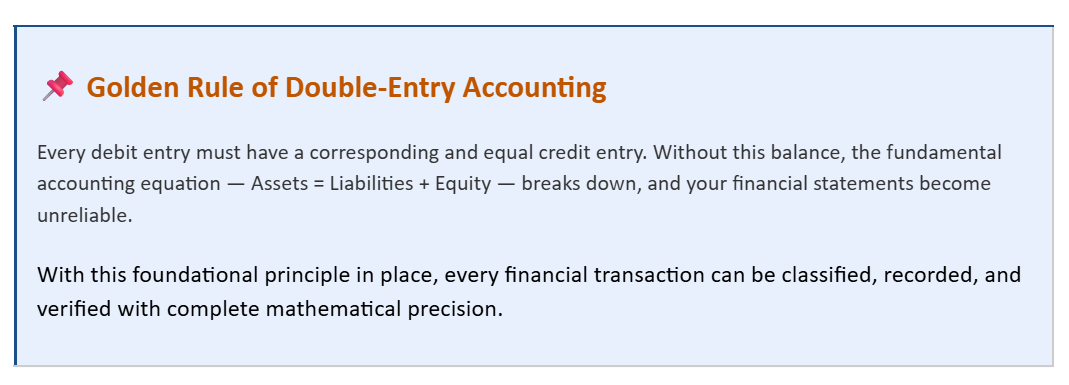
Assets and Expenses: Increase with debits, decrease with credits. Liabilities, Equity, and Revenue: Increase with credits, decrease with debits. The critical principle is that the total debits in every journal entry must exactly equal the total credits — no exceptions.
Each entry in the debit and credit table should include: the transaction date, the name of the account being debited, the name of the account being credited (typically indented), the monetary amounts for each side, and a brief narrative description of the transaction.
The following is a sample debit and credit table for a trading company:
Notice that in every entry above, the debit column total equals the credit column total. This parity confirms the correct application of double-entry bookkeeping and ensures the integrity of the balance sheet.
A consistently maintained debit and credit table is the single most reliable safeguard against the accumulation of undetected accounting errors over time.
Nama Trading Co. purchases computers and printers worth SAR 15,000 from a supplier, payable within 90 days. The journal entry is: Debit — Equipment Account (fixed asset): SAR 15,000. Credit — Accounts Payable (liability): SAR 15,000. Explanation: The asset enters the business (debit), and an obligation to the supplier is created (credit).
The company completes a consulting engagement and receives SAR 7,500 in cash immediately upon service delivery. The journal entry is: Debit — Cash/Bank Account: SAR 7,500. Credit — Service Revenue: SAR 7,500. Explanation: Cash flows into the business (debit), and revenue is recognized (credit).
At month-end, the company transfers SAR 45,000 in salaries via bank transfer. The journal entry is: Debit — Salary Expense: SAR 45,000. Credit — Bank Account: SAR 45,000. Explanation: The expense is recognized (debit), and the bank balance decreases (credit).
These worked examples demonstrate that even complex multi-step transactions resolve cleanly into balanced journal entries when the double-entry rules are applied consistently.
Understanding the debit and credit table is only half the challenge. In practice, a growing business processes hundreds or thousands of transactions per month, making manual journal entries both inefficient and error-prone. This is where enterprise resource planning (ERP) systems become indispensable — and HAL ERP, developed by HAL Simplify, stands out as the leading solution designed specifically for Saudi Arabian and GCC businesses.
Every transaction recorded in HAL — whether a purchase order, a sales invoice, or a payroll run — automatically generates the corresponding debit and credit entries in the general ledger. This eliminates manual data entry errors and ensures that your debit and credit table is always up-to-date and balanced. Clients report achieving a 145% return on investment after adopting the HAL platform.
HAL ERP is fully compliant with the ZATCA Phase II e-invoicing requirements, which mandate real-time transmission of invoice data to the ZATCA Fatoora platform. The system has successfully processed over 300 million invoices for Al Haram retail chain — demonstrating its capacity to handle enterprise-scale transaction volumes while maintaining complete double-entry accuracy.
HAL's interactive dashboards give finance teams instant access to trial balances, balance sheets, accounts receivable aging reports, and accounts payable summaries — all derived from the underlying debit and credit table. Reports can be filtered by period, project, department, or branch, and shared instantly via WhatsApp — a first-of-its-kind feature among ERP systems in the region.
Through HAL's deep WhatsApp integration, an accounts manager can query the balance of a specific debtor account, confirm a supplier credit entry, or request a salary payslip — all within a WhatsApp conversation, powered by the AI agent team embedded in the HAL platform. This eliminates the friction of traditional ERP navigation and brings financial data to where decisions are made.
By automating the mechanical aspects of double-entry bookkeeping, HAL ERP frees finance teams to focus on analysis and strategy rather than data entry and error correction.
The debit and credit table does not exist in isolation — every entry flows directly into the three core financial statements that define a company's financial health:
The balance sheet is the direct expression of the accounting equation: Assets = Liabilities + Equity. Every debit entry that increases assets must be matched by a credit entry that either increases liabilities/equity or decreases another asset. The precision of the debit and credit table is the sole guarantor of balance sheet accuracy.
Revenue accounts — which carry natural credit balances — capture the value generated for the business. Expense accounts — carrying natural debit balances — capture the costs incurred. The difference between total revenues and total expenses yields the net profit or loss reported to shareholders and regulators at the end of each financial period.
Analyzing debit and credit balances in cash and bank accounts enables accountants to prepare the cash flow statement, which breaks down money movements into operating, investing, and financing activities. For lenders, investors, and boards of directors, the cash flow statement built on an accurate debit and credit table is often the single most important financial document.
Every figure that appears on a financial statement traces back to a specific debit or credit entry — making the integrity of those entries the ultimate determinant of financial statement reliability.
Mastering the debit and credit table is not an academic exercise reserved for professional accountants. It is a practical skill that every business owner, financial manager, and entrepreneur needs to make sound, data-driven decisions. By recording every transaction correctly — with equal debits and credits, applied to the right accounts — you ensure that your financial statements are accurate, your regulatory obligations are met, and your business decisions are grounded in reliable data.
If you are looking for a technology partner that makes this process effortless and error-free, HAL ERP — purpose-built for Saudi Arabia, the UAE, and the wider GCC market — delivers complete automation of your debit and credit workflows, full ZATCA compliance, and real-time financial intelligence that empowers faster and smarter decision-making.