

EBITDA, or Earnings Before Interest, Taxes, Depreciation, and Amortization, is a financial metric widely used to evaluate a company’s performance. It provides a clear picture of a company’s operational profitability by excluding costs that are not directly tied to its core business operations. In other words, EBITDA focuses on the profits generated from normal business activities, making it a useful metric for comparing companies within the same industry, irrespective of their tax structures and capital expenditures.
Recent research highlights the importance of EBITDA, with a 2025 SSRN study revealing that analysts have provided this information for over 85% of firms since 2015. It indicates that EBITDA has achieved near-universal coverage among financial analysts. This widespread use reflects its critical role in professional investment analysis.
In this blog, we will dive into the definition, calculation, and importance of EBITDA, and explore how it compares to other financial metrics like EBIT and EBT.
Quick Summary:
EBITDA stands for Earnings Before Interest, Taxes, Depreciation, and Amortization. It is a measure of a company’s profitability that focuses on its core operations by excluding non-operating expenses. By stripping out interest, taxes, depreciation, and amortization, EBITDA offers a clearer view of a company's operational efficiency and profitability.
EBITDA is especially useful for comparing companies in the same industry, as it removes variables such as tax differences, capital expenditures, and accounting practices. Investors and analysts use this metric to determine the financial performance of a business, allowing for better comparisons across companies, regardless of their size or structure.
Also Read: Why Accounting Matters for Business Success
With an understanding of EBITDA, let’s now look at how this metric is calculated.
EBITDA is calculated by taking a company's operating income and adding back interest, taxes, depreciation, and amortization. It simplifies the financial picture by focusing on core business activities.
EBITDA Formula:
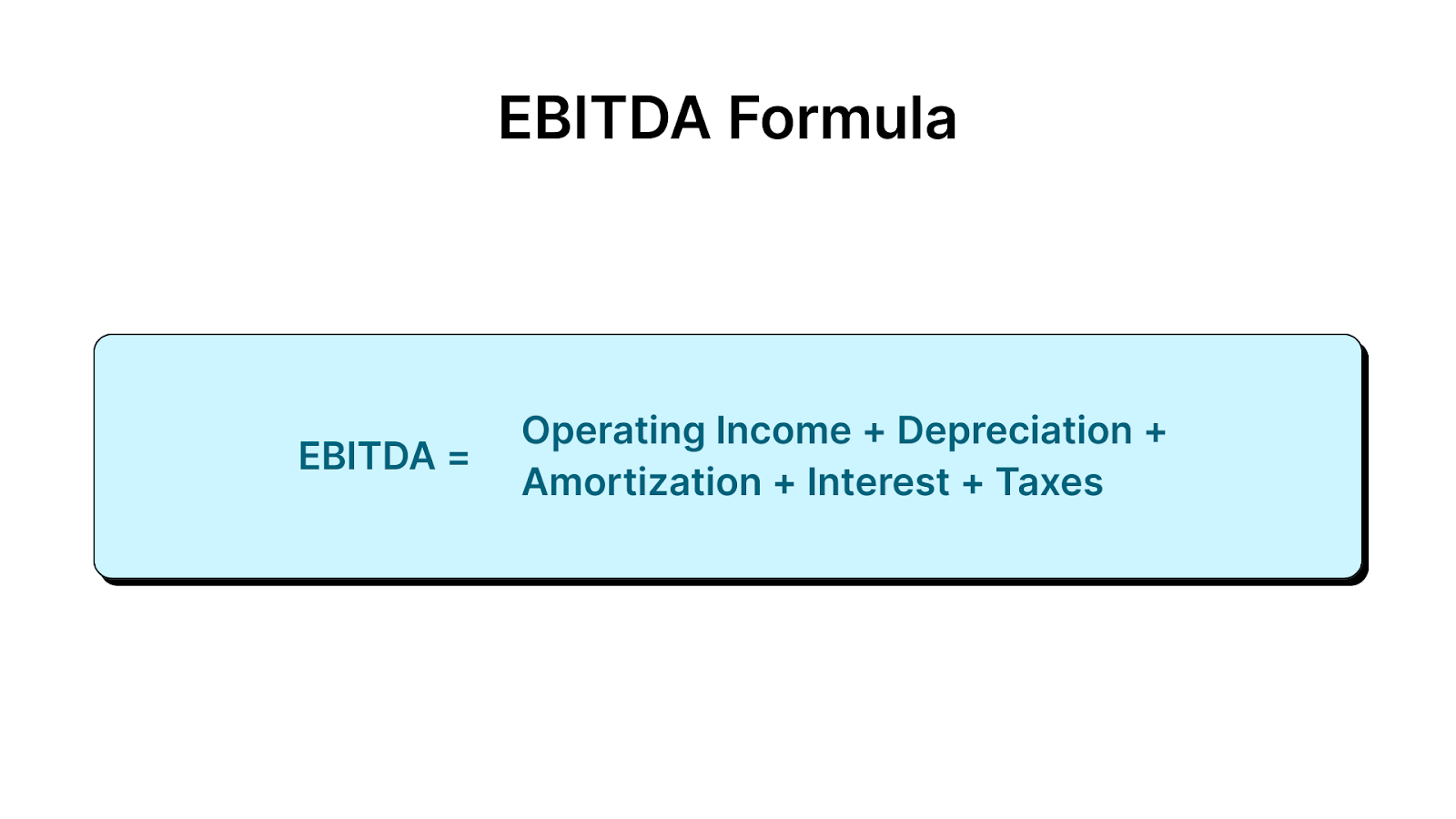
EBITDA=Operating Income+Depreciation+Amortization+Interest+Taxes
Alternatively, you can calculate EBITDA using net income:
EBITDA=Net Income+Interest+Taxes+Depreciation+Amortization
By adding back these non-operating costs, EBITDA reflects the company’s ability to generate earnings from its core operations.
Here is a practical example of how EBITDA is calculated for a company, say XYZ Ltd.
The following snapshot from XYZ Ltd.’s balance sheet, as of December 31, 2024, and March 31, 2025, serves as an illustrative example for EBITDA calculation.
In this example, XYZ Ltd.'s EBITDA for December 2024 is SAR 2,500,000, and for March 2025, it is SAR 2,970,000. The company’s EBITDA shows an increase, indicating a growth in its operational earnings.
Also Read: Understanding Profit Margin and How to Calculate It
This rise in EBITDA highlights stronger core performance over time. Let’s now explore what EBITDA actually reveals about a company’s financial health and operational efficiency.

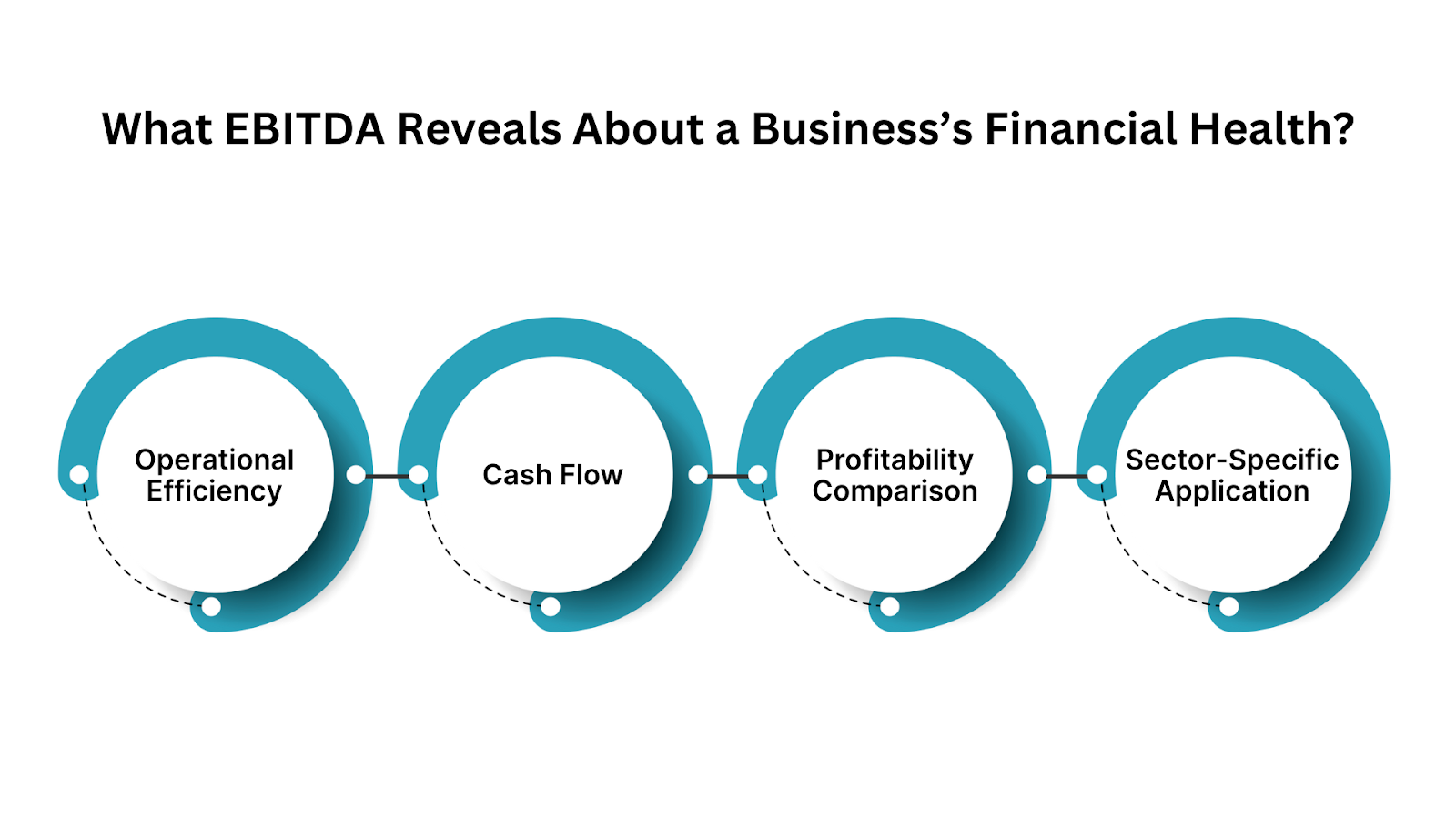
EBITDA serves as a key indicator of a business’s financial health by measuring the profitability of its core operations, excluding non-operational factors like taxes, interest, depreciation, and amortization. This metric is crucial for assessing several aspects of a company’s performance:
To see how this works in practice, let’s look at a real-world Saudi example where EBITDA focus directly improved profitability:
In 2024, STC reported EBITDA growth of 6.6%, with margins improving to 31.5% compared with 31.3% the previous year. This gain was supported by an Operational Efficiency Program, which offset falling B2B revenue and protected profitability at the operating level. The example shows how focusing on EBITDA can help Saudi companies control costs and maintain stronger financial outcomes over time.
In regions like Saudi Arabia, where compliance with ZATCA (Zakat, Tax and Customs Authority) is mandatory, understanding your EBITDA becomes even more important. It helps businesses plan for VAT obligations and assess how much profit is generated from operations before taxes and other regulatory costs impact the bottom line.
Now that we’ve explored EBITDA’s significance, let’s look at how it compares to other financial metrics, such as EBIT and EBT, to gain a broader perspective on profitability.
EBITDA, EBIT (Earnings Before Interest and Taxes), and EBT (Earnings Before Taxes) are all important financial metrics, but they differ in terms of what they include.
Also Read: Financial Accounting Made Simple: Principles, Types, and Key Functions
Let’s move on to understanding EBITDA margin, which helps evaluate a company's operating efficiency further.
The EBITDA margin is a profitability ratio that measures the relationship between EBITDA and total revenue. It shows how much profit a company generates from its core operations before accounting for non-operating expenses, taxes, and depreciation. The EBITDA margin is useful for assessing a company's operational efficiency and comparing its profitability against industry peers.
EBITDA Margin Formula:
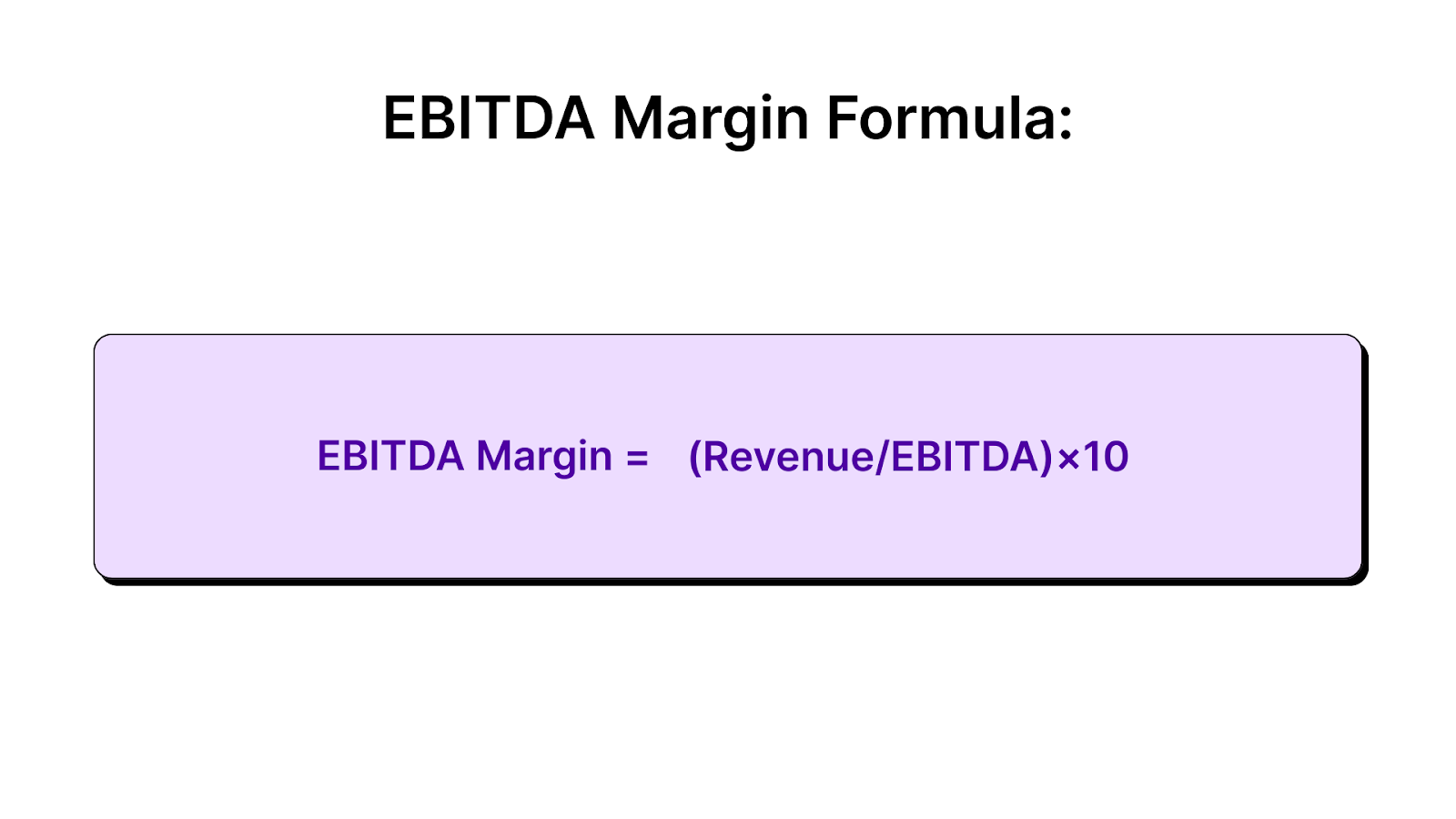
EBITDA Margin = (Revenue/EBITDA)×10
A higher EBITDA margin indicates a more profitable company, meaning it can generate a higher proportion of profit from its sales relative to its revenue. It’s also an indicator of how well a company controls its operating costs.
Practical Example:
Let's say two companies, ABC Private Limited and XYZ Private Limited, have the following EBITDA and total revenue figures:
Although XYZ has a higher EBITDA value, ABC Private Limited has a higher EBITDA margin, meaning it generates a higher proportion of profit from its revenue. This makes ABC more financially efficient and potentially more attractive to investors, as a higher margin generally indicates a business is better at converting sales into actual profit.
The EBITDA margin also provides a benchmark for investors when comparing companies in the same industry, offering valuable insight into which companies are better positioned for growth.
While margin highlights earnings efficiency, investors and lenders also want to know if those earnings can cover debt. This is where the EBITDA coverage ratio becomes essential.
The EBITDA coverage ratio is a financial metric that evaluates a company’s ability to cover its debt obligations using its EBITDA. It is useful for creditors and investors to assess whether a company has enough operating profits to meet its debt payments, including both principal and interest. This ratio provides insight into the financial health of a business, especially in terms of its debt repayment capability.
EBITDA Coverage Ratio Formula:
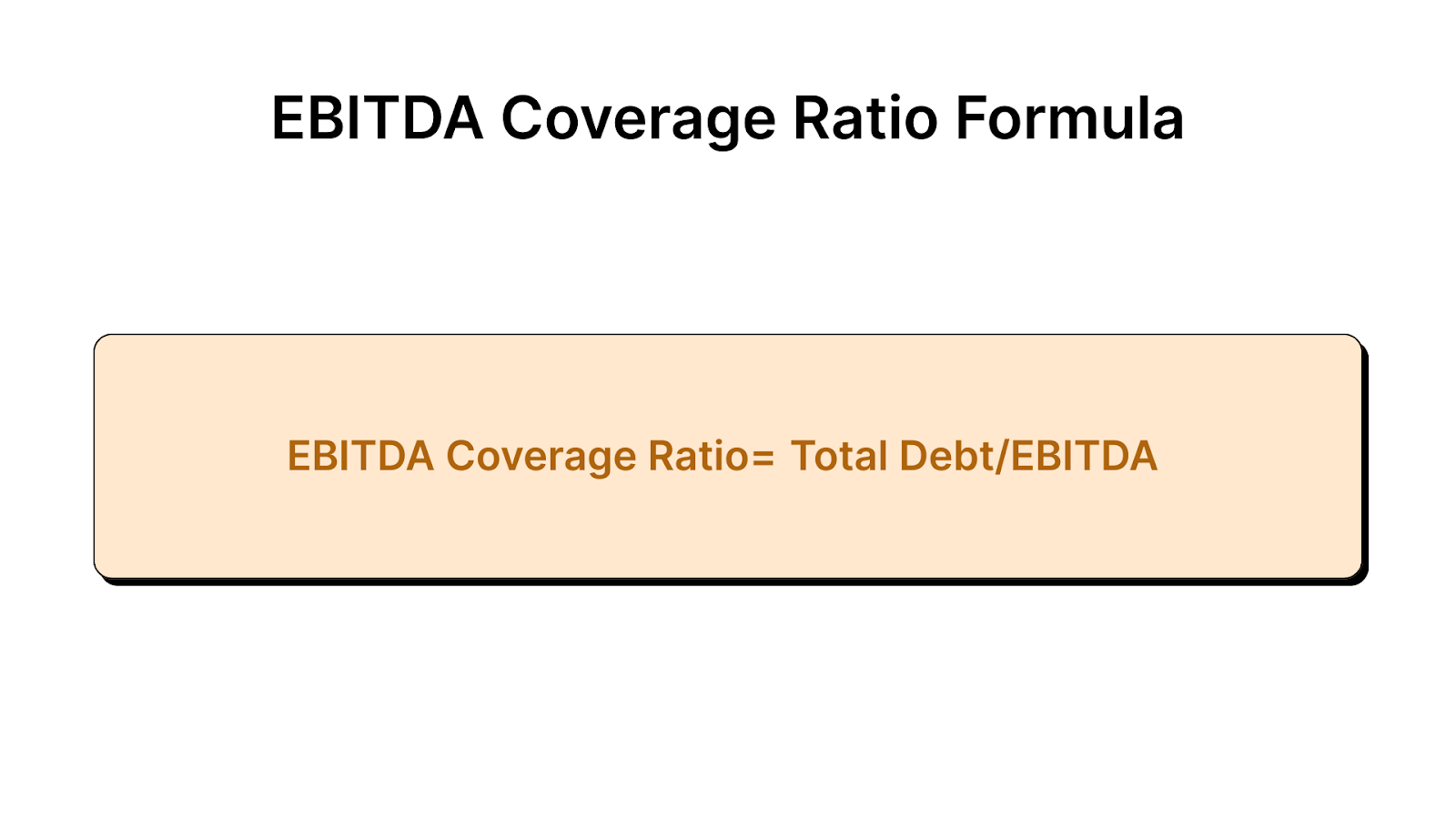
EBITDA Coverage Ratio=Total Debt/EBITDA
A higher EBITDA coverage ratio indicates that the company has more operating profit available to cover its debt obligations, making it less likely to default on debt payments. It also provides reassurance to creditors that the business can manage its debt load effectively.
However, it is important to distinguish between the EBITDA coverage ratio and the EBITDA-to-interest coverage ratio. While both metrics measure a company’s ability to service its debt, the EBITDA-to-interest coverage ratio specifically focuses on whether the company's earnings before interest, taxes, depreciation, and amortization are enough to cover its interest expenses, typically excluding principal and lease payments.
For example, the EBITDA-to-interest coverage ratio can be calculated as:
EBITDA-to-Interest Coverage Ratio= (EBITDA+Lease Payments) / (Interest Payments+Principal Payments+Lease Payments)
If the EBITDA coverage ratio or the EBITDA-to-interest ratio is greater than 1, it indicates the company is in a healthy financial position and capable of repaying its liabilities. The higher the ratio, the stronger the company’s ability to meet its financial obligations.
While coverage ratios assess debt-servicing strength, understanding the broader pros and cons of EBITDA is key to using it effectively in financial analysis and decision-making.
While EBITDA is a valuable financial metric, it comes with both advantages and limitations. Here's a comparison table that highlights both:
Despite its limitations, EBITDA remains an essential metric for evaluating a company’s operational performance. However, it is important to use it in conjunction with other financial metrics to get a more accurate picture of a company’s overall financial health.

Also Read: Best Accounting Software For Your Online Retail Business
To truly use EBITDA and other financial metrics, businesses need real-time visibility and control over their financial data. That’s where HAL ERP becomes an indispensable solution for smarter financial management. Let’s discuss how HAL ERP serves this purpose.
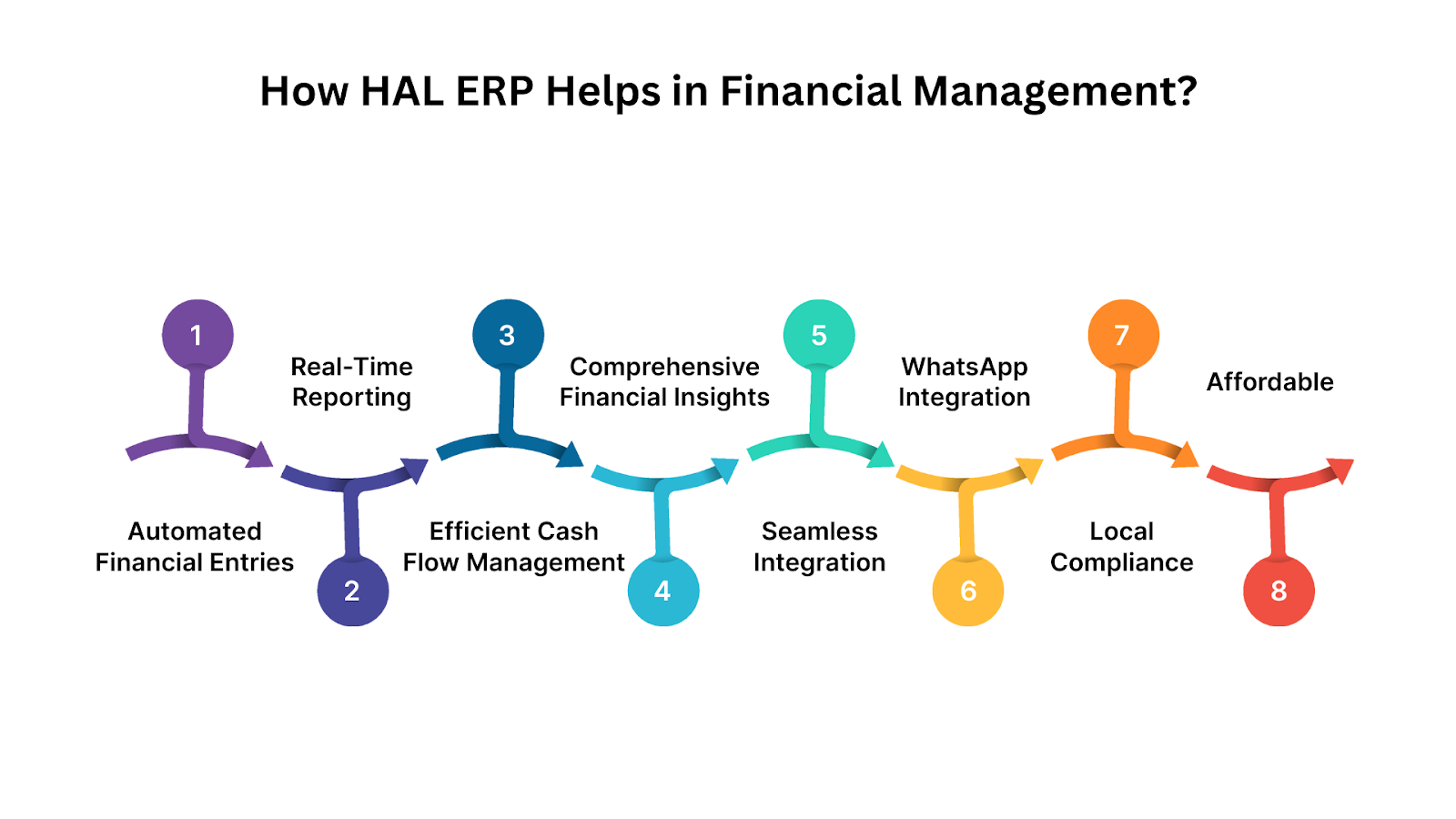
HAL ERP simplifies financial management by offering powerful tools that seamlessly integrate all aspects of business finances. From automating data entry to providing up-to-date insights, HAL ERP ensures businesses can manage their finances efficiently and effectively. Here’s how HAL ERP supports businesses:
Also Read: ERP Implementation Success Stories: Real-World Examples
Understanding EBITDA is essential for assessing a company’s operational profitability and financial health. This metric offers a clear view of a company’s ability to generate earnings from core operations, excluding non-operating factors.
EBITDA is not just useful for business owners but also for investors and analysts who rely on it to compare companies across industries. However, like all financial metrics, it should be used in conjunction with other financial data for a comprehensive evaluation.
Ready to enhance your financial management with accurate insights? Learn how HAL ERP can help streamline your financial processes and optimize your business operations by booking a demo today!
EBITDA margin (% of revenue) is better when comparing companies of different sizes. It reflects how efficiently a company turns revenue into operating profit, providing a more normalized comparison across competitors.
Yes. A high EBITDA doesn’t always mean strong financial health, it ignores debt levels and capital needs. For example, a capital-intensive business might have good EBITDA but poor free cash flow due to high investment requirements.
Yes. Many exclude non-recurring zakat/tax items (e.g., retrospective assessments), but must disclose the method clearly under Tadawul and CMA guidelines for transparency and comparability.
Lenders use the EBITDA coverage ratio to assess whether a company can meet its debt obligations. A higher ratio indicates a stronger ability to repay, reducing the risk of default and increasing creditworthiness.
HAL ERP automates financial reporting, tracks real-time EBITDA performance, and ensures compliance with local tax and accounting regulations—helping businesses optimize cash flow, reduce errors, and make data-driven decisions.