

Struggling to meet business targets while keeping operations running smoothly? Most teams lack consistent guidance, and only 26% of employees receive weekly coaching. This leaves leaders without real-time insights and keeps employees tied up in repetitive tasks, rather than focusing on high-impact work that drives revenue and project delivery. Structured coaching has been shown to improve performance outcomes by 28%.
AI Sales Coaching integrates with enterprise workflows to provide real-time guidance and accelerate skill development. It also gives leaders measurable insights across finance, procurement, retail, and supply chain departments, enabling smarter decision-making and predictable business outcomes.
In this blog, you’ll learn how AI Sales Coaching can improve your team’s skills, close more deals, and increase overall business performance.
AI Sales Coaching uses automation and data analytics to improve team performance and workflow efficiency across departments. Analyzing workflows, communications, and process data provides real-time, actionable feedback to employees while giving leaders performance insights without manual review.
The system continuously tracks progress, identifies skill gaps, and adapts guidance to individual and team strengths. Teams improve productivity, shorten onboarding, optimize processes, and enhance decision-making, allowing leaders to focus on strategic growth, revenue, and cross-functional performance.
The benefits are clear, but how exactly does AI turn data and insights into measurable business results?
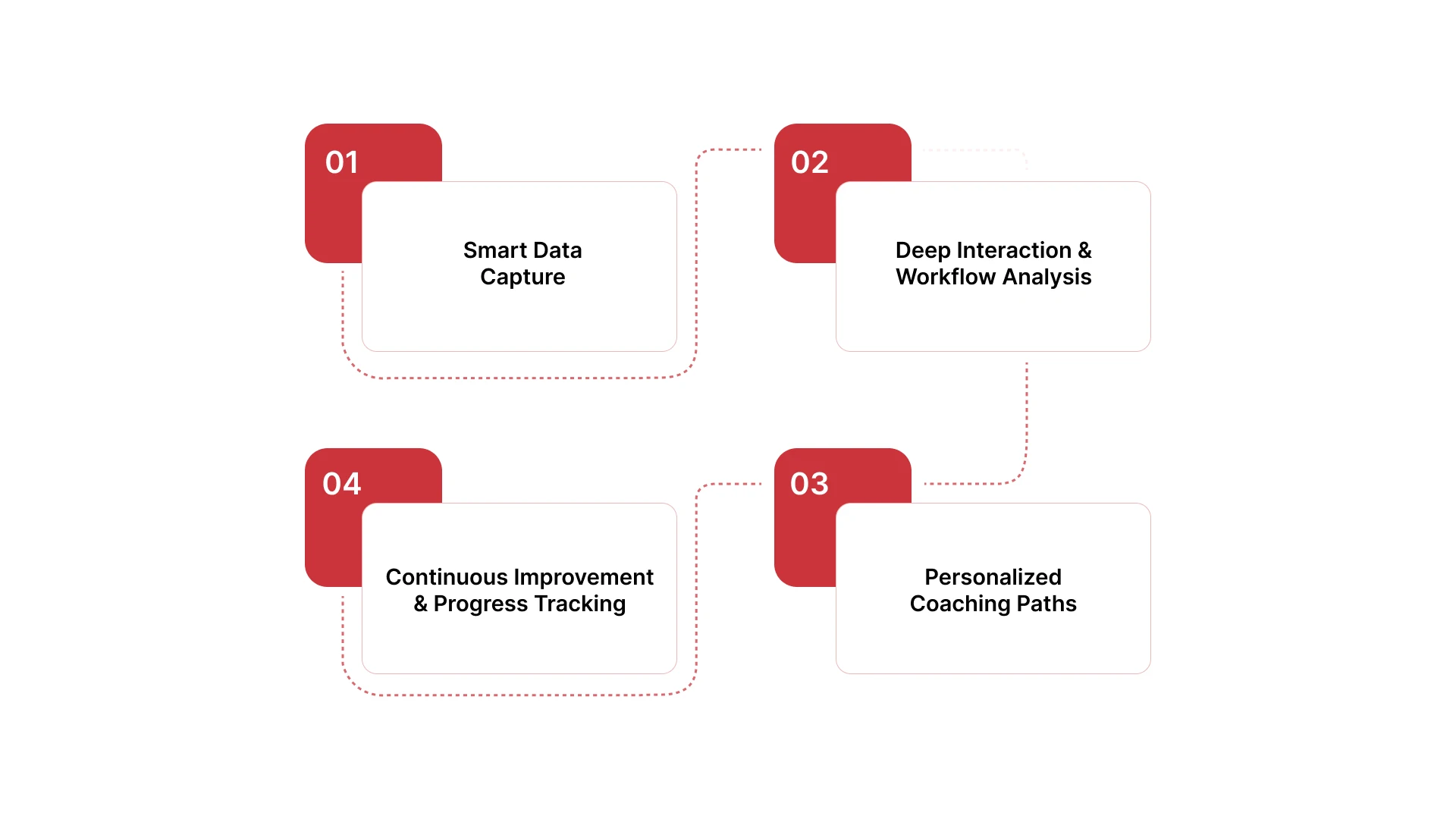
AI Sales Coaching transforms everyday team activities into actionable insights that employees can apply immediately. It ensures learning happens in context, improving skills while giving leaders visibility into performance, process effectiveness, and predictable business outcomes.
AI collects all relevant data across departments to create a unified picture of team and workflow activity:
AI evaluates workflows and interactions to identify patterns, bottlenecks, and areas for improvement:
AI recommends guidance and training tailored to individual or team needs:
Performance is monitored over time to identify trends and recurring gaps:
By following these steps, AI Coaching helps teams work more efficiently, reduce operational risk, accelerate onboarding, and improve overall business performance.

To achieve these results consistently, it’s important to choose AI Sales Coaching tools with features that directly support team performance and give measurable business impact.
Most AI coaching platforms look similar in demos. The real difference is whether a tool can capture real team behavior, link it to measurable outcomes, and make coaching actionable across daily workflows. Use this checklist to evaluate tools that drive performance, efficiency, and strategic results across departments.
Automatically captures meetings, communications, and workflow activity, highlighting critical moments such as process bottlenecks, missed deadlines, or strong performance. Timely alerts help teams act quickly and give leaders immediate visibility into operational risks.
Dashboards track team-wide trends, skill gaps, and operational benchmarks. Linking coaching outcomes to revenue, cost efficiency, and workflow metrics ensures ROI is transparent and supports strategic decision-making.
Personalized guidance allows employees or teams to focus on high-impact development areas. This accelerates onboarding, improves skill efficiency, and aligns coaching with organizational goals and department workflows.
Integration with ERP, CRM, email, and collaboration tools ensures insights appear where teams already work. Teams can act on recommendations immediately without disrupting operations, improving adoption and productivity.
Standardizes coaching practices across departments, regions, or hybrid teams. This reduces managerial workload while maintaining consistent performance and promoting shared best practices.
Tracks long-term patterns, recurring challenges, and performance trends. Insights help leaders maintain operational reliability, plan strategically, and support ongoing skill development across the organization.
Selecting a tool with these capabilities ensures AI Coaching delivers measurable business impact, accelerates performance improvement, and supports consistent results across departments and workflows.
Also Read: AI for Sales Forecasting: Everything Enterprises Need to Know
Features are powerful, but results come from action. Let’s discover how AI Sales Coaching transforms insights into measurable business outcomes across teams and departments.
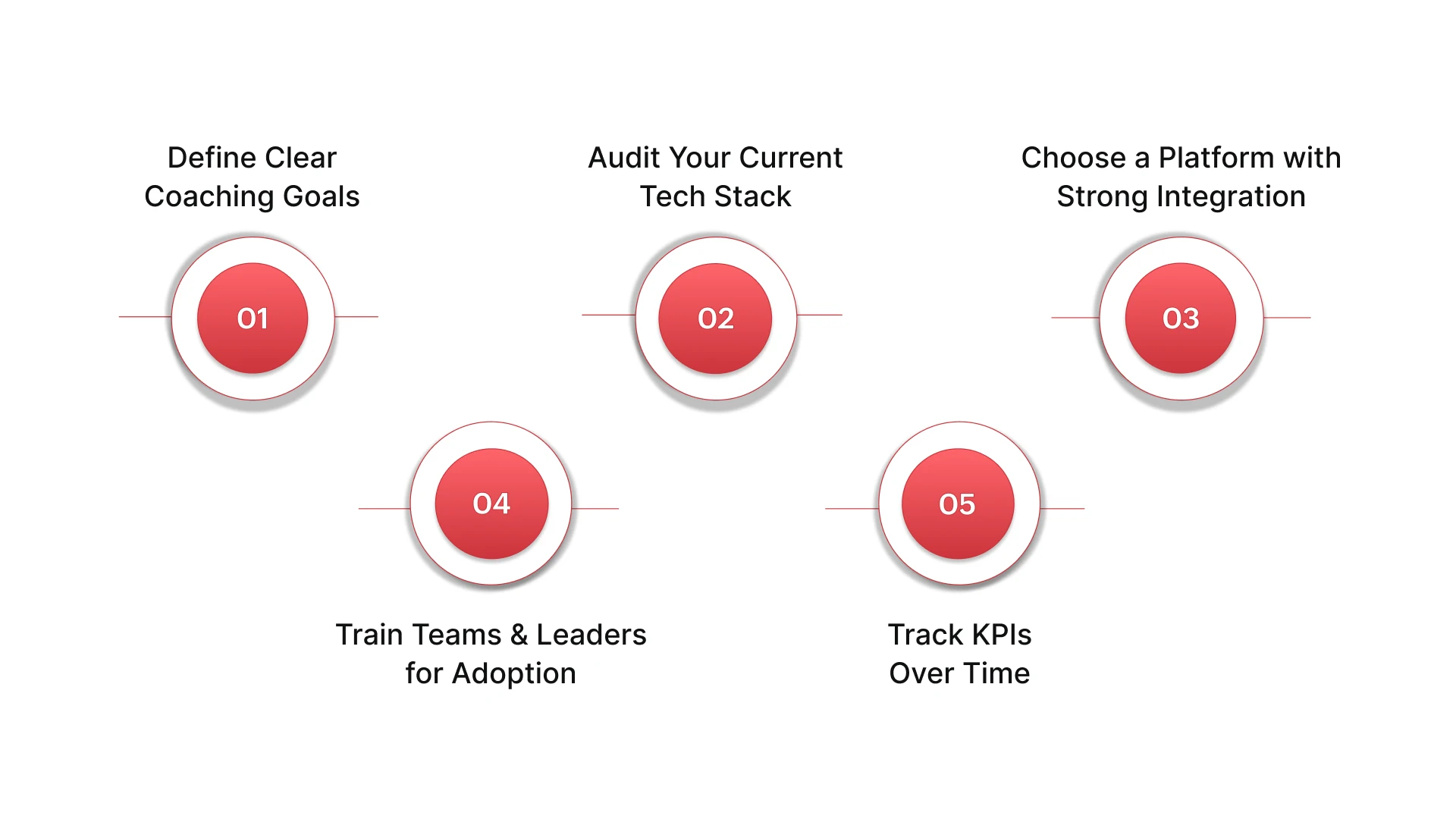
AI Sales Coaching delivers results when treated as a B2B enterprise performance system, not just a tool rollout. The goal is simple: connect coaching insights to behaviors and workflows that drive measurable business outcomes, and make it easy for leaders and teams to act on them consistently.
Start by defining the key outcomes that matter most across departments. Clear goals ensure AI insights translate into meaningful action:
Identify where activity and data live today and where AI coaching needs to be integrated. A complete view ensures insights are embedded in daily workflows:
Integration is key to adoption. Ensure AI insights flow naturally into tools your team already uses:
Most rollouts fail because teams don’t understand how to use insights:
Focus on metrics that link behavior change to measurable business outcomes:
By following these steps, AI Sales Coaching becomes a repeatable system that boosts team performance, accelerates onboarding, and strengthens operational outcomes — helping leaders across finance, operations, procurement, retail, and project management drive measurable business results.
By turning insights into action, AI Sales Coaching helps your teams consistently improve performance and achieve predictable results.

AI Sales Coaching turns insights from everyday team activities into actionable guidance, helping organizations improve performance, accelerate onboarding, and achieve predictable results across departments. Here are key benefits:
Also Read: ERP vs WMS: Key Differences in Warehouse Management
While AI Sales Coaching offers clear benefits, implementing it effectively requires planning. Let’s explore common challenges and how organizations can overcome them to maximize results.
Implementing AI Sales Coaching can transform team performance and workflow efficiency, but organizations often face obstacles. Addressing these early ensures your investment drives measurable business results.
1. Resistance to Change: Teams may hesitate to adopt AI tools, fearing surveillance or added workload.
Solution: Emphasize that AI insights support skill development, process improvement, and workflow efficiency. Start with pilot programs and share success stories to build trust.
2. Data Quality Issues: AI relies on accurate and complete data from ERP, CRM, emails, and communications. Inconsistent or missing data can reduce effectiveness.
Solution: Audit your tech stack, standardize data entry, and integrate all relevant systems before rollout.
3. Integration Challenges: Poorly integrated tools can disrupt workflows, creating friction instead of efficiency.
Solution: Choose platforms that seamlessly integrate with ERP, CRM, and collaboration tools. Ensure AI insights flow directly into daily operations.
4. Manager Adoption and Training: Leaders may struggle to interpret AI insights or prioritize improvement actions.
Solution: Train managers on dashboards, actionable insights, and weekly review rhythms. Focus on “coaching by exception” to save time and maximize impact.
5. Measuring ROI: Without clear metrics, organizations may struggle to link AI coaching to tangible business results.
Solution: Track key KPIs, including workflow efficiency, process completion, team adoption, and measurable workflow improvements. Review trends regularly to adjust strategies.
With the right approach, AI Sales Coaching can boost performance, simplify workflows, and deliver predictable results across finance, operations, project management, and other key departments. Let’s see how HAL ERP makes this a reality for Saudi enterprises.
HAL ERP utilizes AI-driven insights to help managers and teams make informed operational decisions without manual oversight. The AI layer works within existing workflows, ensuring guidance is relevant, timely, and easy to act on across finance, operations, project management, and other departments.

Many medium-sized businesses in Saudi Arabia struggle to meet operational and performance goals because traditional workflows cannot keep up with fast-moving demands. AI-driven insights in HAL ERP transform real-time data from your workflows into actionable guidance, helping teams operate efficiently and make informed decisions.
HAL ERP uses AI-powered analytics and workflow automation to give leaders across finance, operations, project management, and other key departments visibility into team performance and process efficiency. Teams can maintain consistent execution without adding managerial overhead.
See the impact for yourself. Book a demo to discover how HAL ERP’s AI-driven insights can accelerate performance and support smarter decision-making across your business.
AI analyzes rep interactions, deal progression, and historical patterns to identify risks early. This ensures that leadership makes data-backed predictions rather than relying on gut feel, improving pipeline reliability and revenue planning.
Yes. AI learns industry-specific deal patterns, objection types, and workflows, making recommendations relevant to sectors such as manufacturing, retail, contracting, and services without requiring generic, one-size-fits-all coaching.
By embedding real-time insights and actionable guidance directly into workflows, AI ensures reps receive consistent coaching, performance visibility, and behavioral feedback regardless of location or time zone.
No. AI acts as a coaching and decision-support layer, guiding managers on next best actions and highlighting risks, while human judgment and strategy remain central to deal execution.
AI provides examples of top-performer interactions, highlights key behaviors, and delivers micro-coaching aligned with live deals, helping new hires quickly adopt best practices and reach productivity faster.