

Your business is likely already using AI in some capacity. But most of that adoption is underpowered. It lives in back-office processes and reporting tools that do not touch revenue directly.
The one area where AI delivers its sharpest return is lead generation. And that is where most enterprises are still operating manually, inconsistently, or with tools that generate volume without generating quality. Gartner predicts that by 2027, 95% of seller research workflows will begin with AI, up from less than 20% in 2024.
That shift is already exposing the businesses that have not caught up. Leads come in but sit unqualified. Follow-ups are late. High-potential prospects go cold before anyone reaches them.
This blog gives you the strategies, the tools, the integration steps, and the honest account of where most AI lead generation efforts break down, so you can build a system that converts consistently instead of one that looks good on paper.
AI lead generation is the use of machine learning, natural language processing, and predictive analytics to identify high-potential prospects, understand where they are in their buying journey, and engage them at the right moment, at a scale and speed that manual methods can't sustain.
Traditional systems rely on fixed triggers such as form submissions or time-based follow-ups. AI systems process multiple signals simultaneously, including engagement patterns, communication history, and firmographic data, to determine which leads require immediate attention and which should remain in nurture cycles.
Three technologies sit at the core of every AI lead generation system. Each one handles a different layer of the problem, and knowing what each does tells you exactly where in your sales process AI will have the most immediate impact.
These layers connect directly to sales workflows, influencing how leads are routed, how quickly responses are triggered, and how opportunities are evaluated over time.
Related: AI for Sales Forecasting: Everything Enterprises Need to Know
Not all AI strategies deliver equally across every sales environment. The six below are chosen specifically because they address the friction points most common in enterprise pipelines, such as long qualification cycles, delayed responses, incomplete lead data, and handoff failures. Here are the approaches worth deploying first.
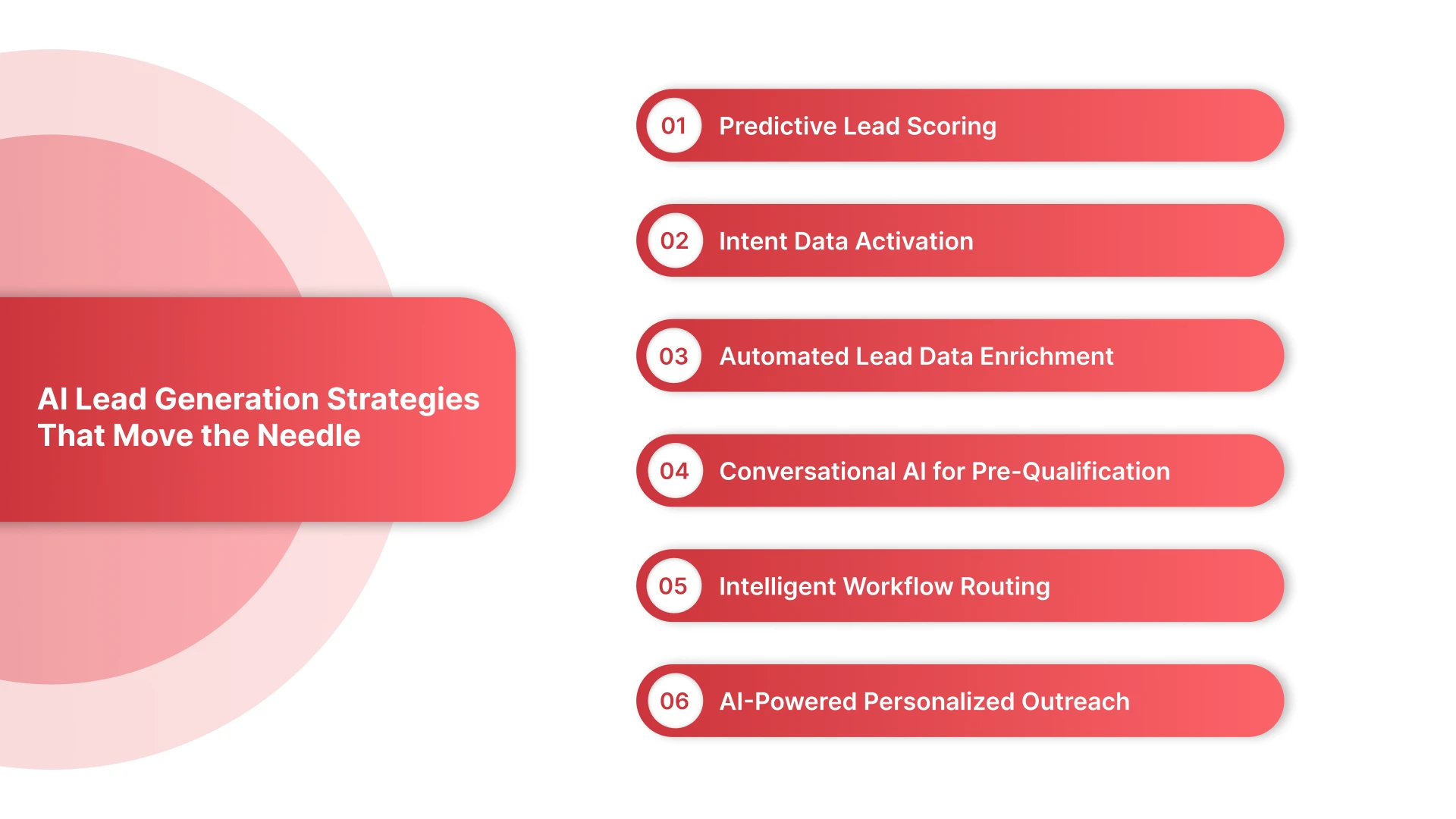
ML models analyze CRM data, behavioral signals, intent indicators, and firmographics to rank leads by conversion likelihood. Unlike static rule-based scoring, predictive models adjust dynamically as new patterns emerge.
High-scoring leads get routed to senior reps immediately; lower-intent leads enter nurture sequences. The result: no lead falls through, and no rep wastes time on unqualified prospects.
AI detects purchase intent before a prospect formally expresses interest through keyword activity, content engagement, website behavior, and third-party data signals.
Activating campaigns against these signals, rather than waiting for form submissions, allows sales teams to engage buyers earlier in the decision process, often before competitors are even aware that a need exists.
AI tools integrate with external data sources to enrich lead profiles in real time, appending job titles, company size, funding status, and technology stack to incomplete records.
This means sales teams always work with full context, and downstream analytics stay accurate. Manual research and outsourced list cleaning become unnecessary.
AI-powered assistants handle initial prospect engagement, including answering questions, qualifying interest, collecting contact details, and routing hot leads to human reps.
Unlike static forms, these tools adapt based on user responses and historical behavior. In enterprise scenarios, a well-deployed conversational AI can qualify a visitor, determine organizational fit, and book a discovery call before a sales rep is involved.
AI orchestrates what happens next based on lead behavior, score, and stage. A high-intent lead from a target sector goes directly to a senior account executive. A lower-intent lead enters a structured nurture sequence.
These routing decisions happen automatically, at the moment they matter, eliminating the delays and miscommunications that plague manual handoffs.
Instead of static templates, AI generates outreach tailored to each prospect's behavior, industry, and engagement history. Subject lines are optimized, send times are predicted, and message content adjusts based on how the prospect has interacted with previous communications.
The output is personalized outreach at scale, without the manual effort that makes personalization unsustainable for large pipelines.
While traditional AI only tracks lead behavior, HAL ERP’s Agentic AI takes it further by embedding intelligent agents into your workflows. It scores leads based on real-time interactions, monitors behavior, and automatically routes high-priority leads to the right team, ensuring no opportunity is missed.

Most sales tools you use today have AI built in to some degree. Some are legacy platforms that have layered AI on top. Others were built on AI from the ground up. What matters is whether the tools you have actually cover the full lead journey, from generating interest to nurturing prospects to converting them into customers.
The five tools below address different stages of that journey. Here is how each one fits.
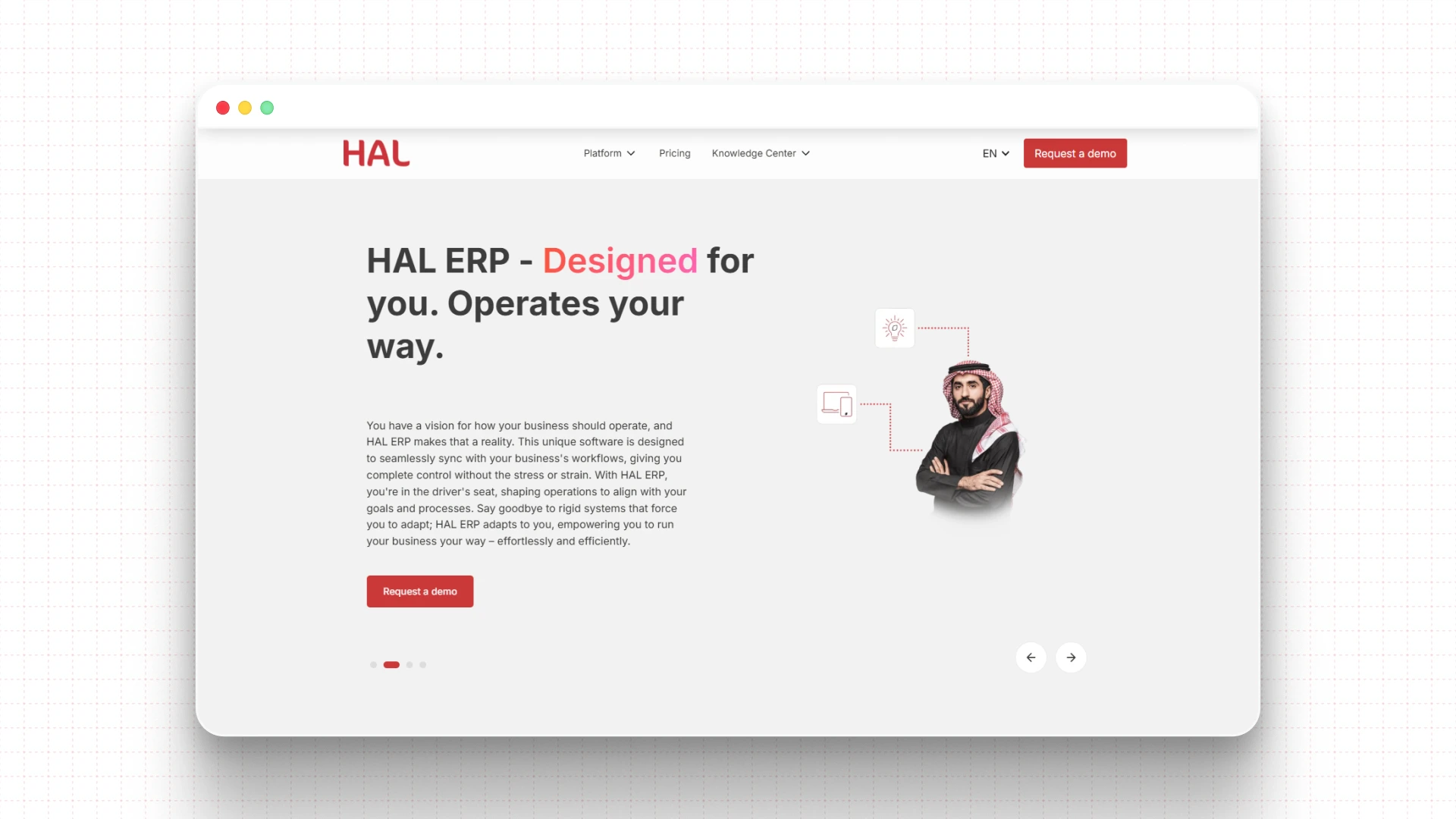
HAL ERP is a cloud-based platform designed for Saudi enterprises, integrating sales, CRM, reporting, and operations in one system. Powered by Agentic AI, intelligent agents are embedded into your workflows, automating processes, detecting issues early, and offering real-time recommendations.
Best for: Enterprises that want unified sales, finance, and operations intelligence in one platform with AI support that works inside daily execution, not alongside it.
Al Homaidhi Group, a luxury retail company, faced challenges with delayed reporting and inefficient pricing across its stores. Managing an omnichannel sales approach was difficult, and real-time visibility into inventory and sales was limited.
With HAL ERP, Al Homaidhi streamlined pricing, inventory management, and sales tracking across all channels. The system helped automate lead qualification and improve decision-making with real-time insights.
Results:

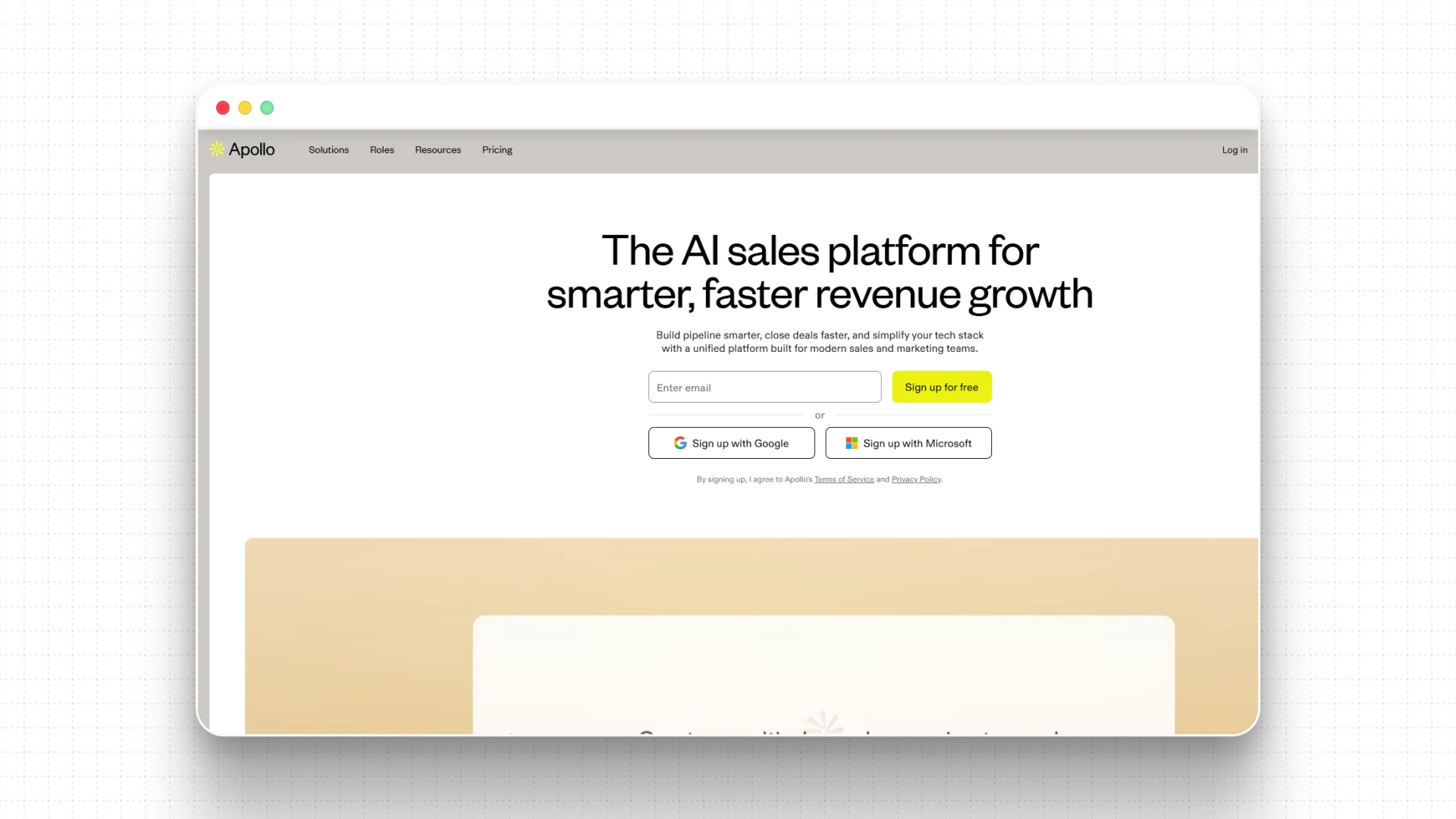
Apollo is a sales intelligence and prospecting platform that combines a large B2B contact database with AI-driven scoring, outreach automation, and workflow features.
Best for: Outbound-driven teams that need one platform for prospecting, prioritization, and sequencing without managing multiple disconnected tools.
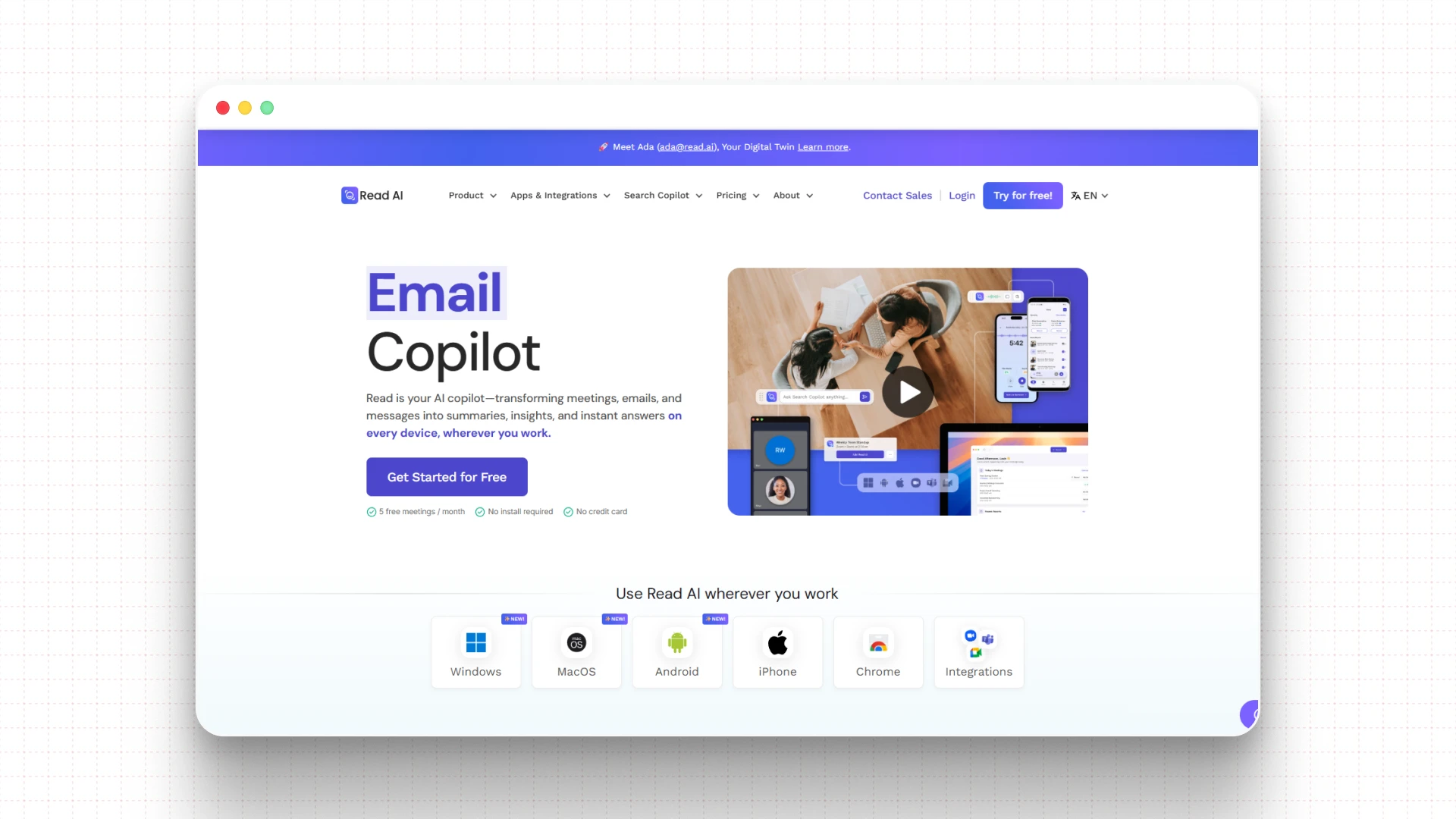
Read AI is a meeting intelligence platform that automatically captures, transcribes, and structures everything that happens during a sales call, turning conversations into searchable context, CRM updates, and next-step recommendations without manual input from the rep.
Best for: Sales teams that lose hours to post-call admin and context reconstruction. Read AI handles notes, CRM updates, and follow-up drafts automatically after each call.
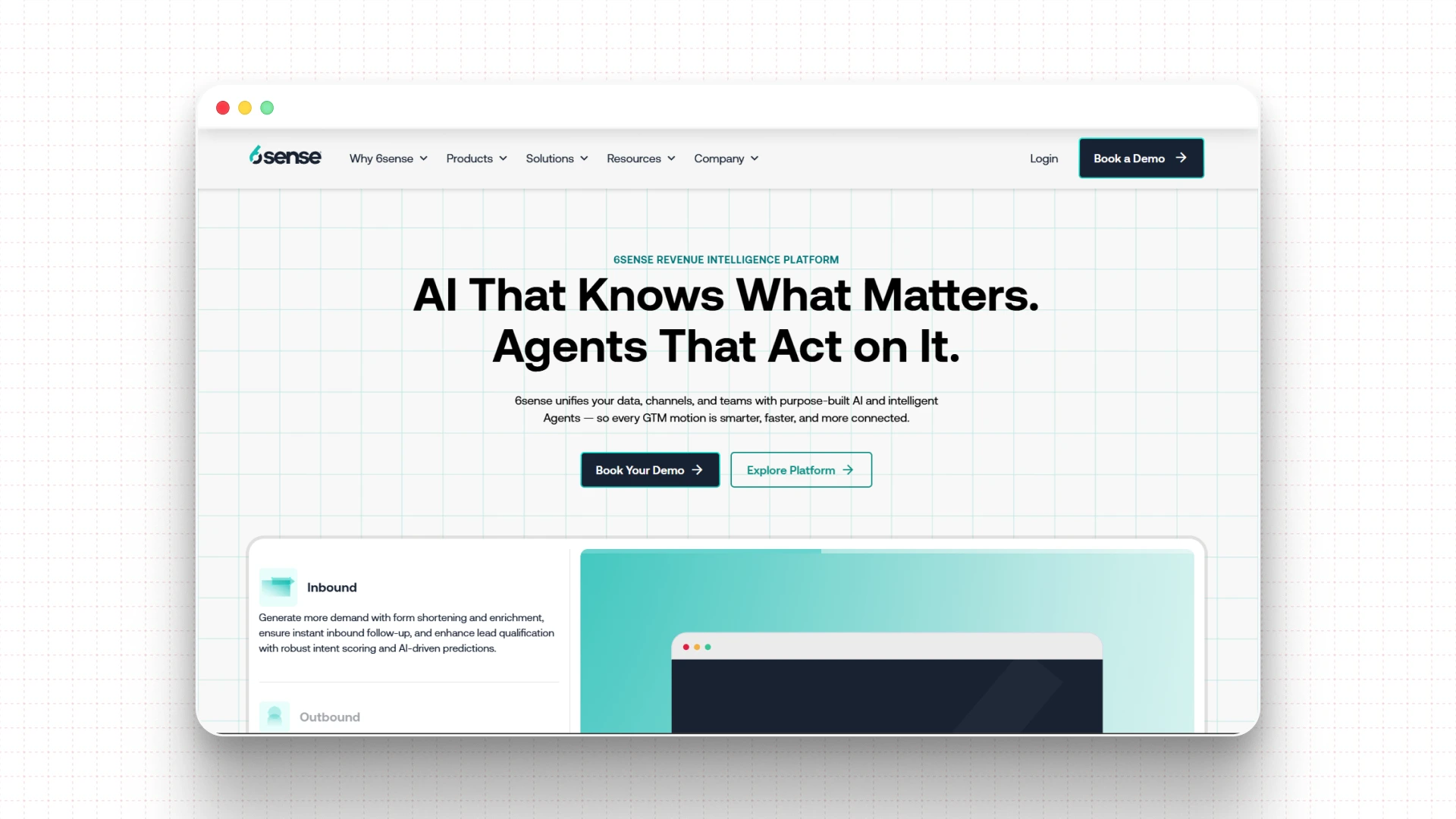
6sense is an account-based marketing and sales intelligence platform focused on identifying in-market accounts using predictive and behavioral signals, before those accounts fill a form or take any known action.
Best for: Enterprise ABM teams that need buying stage visibility and account-level prioritization to coordinate sales and marketing around the same in-market accounts simultaneously.
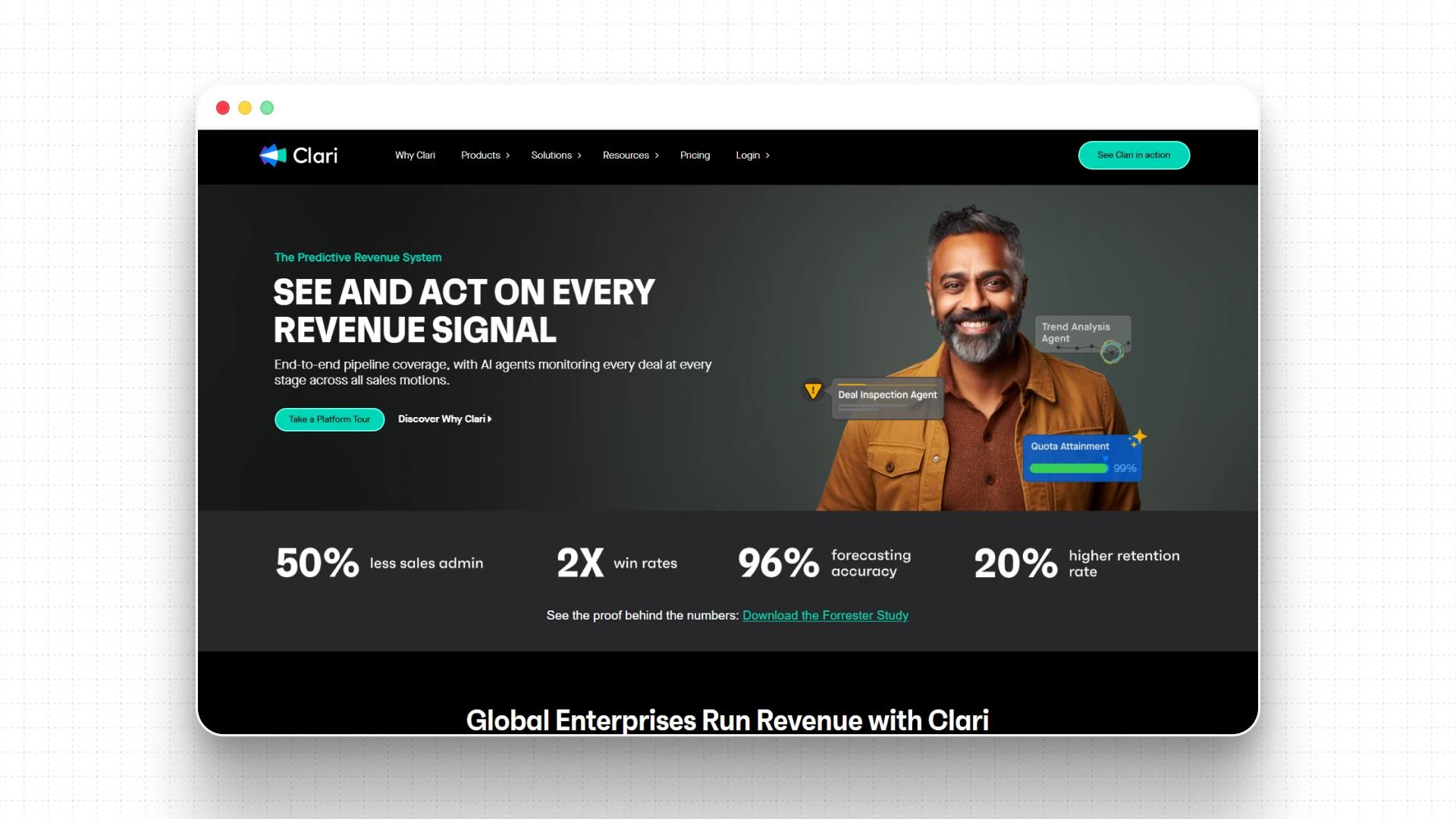
Clari combines CRM data, activity signals, and engagement patterns to forecast revenue and surface deal risk. Sales leaders use it to manage team forecasts and identify at-risk opportunities based on signals that go beyond CRM stage progression.
Best for: Sales organizations that need systematic forecast accuracy and pipeline risk visibility.
AI adoption often fails during early rollout due to unclear ownership, incomplete data, and misalignment with existing decision processes. These issues appear before technology performance becomes a factor.
A structured integration approach connects AI outputs to actual revenue decisions, ensuring the system influences how leads are evaluated and progressed.
These six steps below reflect what a grounded, enterprise-ready integration actually looks like.
Also read: Sales Process Automation in 2026: How ERP Closes Deals Faster in KSA
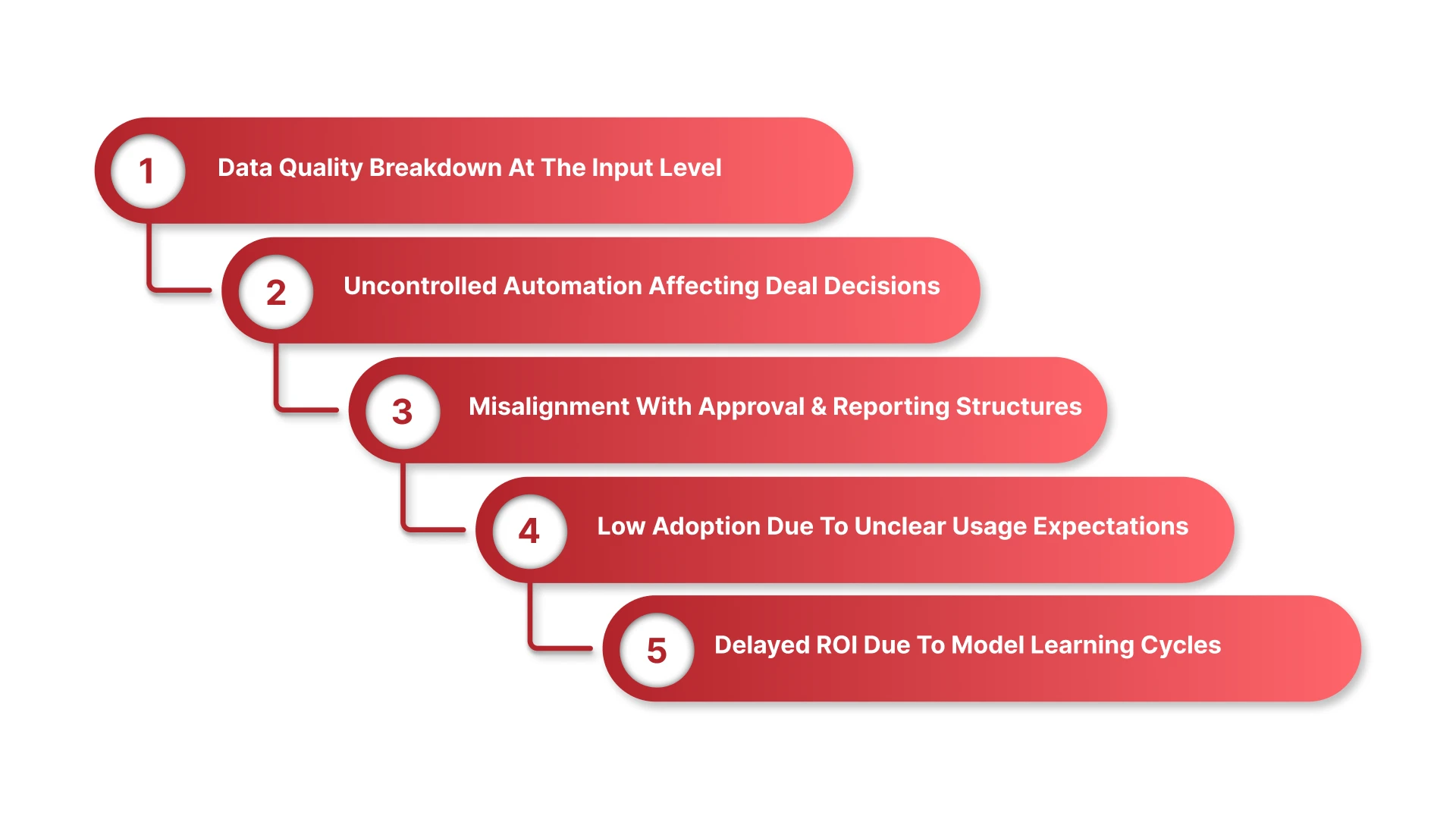
AI lead generation systems break down at specific points inside operations, data pipelines, and decision structures. These issues show up early in rollout and directly affect lead quality, routing accuracy, and pipeline reliability.
Here are the failure points and how they need to be handled:
AI models depend on structured, complete CRM data. Missing fields, inconsistent tagging, duplicate records, and disconnected systems distort lead scoring and routing decisions. For example, if deal stages are updated inconsistently across teams, the model misreads conversion signals and inflates low-quality leads.
What to do: Standardize CRM fields, enforce mandatory data entry for key attributes, remove duplicates, and align definitions across teams before deployment. Data governance needs ownership, not periodic cleanup.
AI systems generate lead scores, recommendations, and engagement triggers. When these outputs are used without validation, teams begin acting on incomplete or misinterpreted signals. This leads to premature escalation of weak leads or neglect of accounts that fall outside historical patterns.
What to do: Define where AI outputs are advisory and where human review is required. For example, AI can prioritize leads and trigger outreach, but deal qualification and progression decisions remain with sales leadership.
Enterprise sales decisions pass through defined authority layers. AI recommendations that appear outside these structures create friction and are often ignored. For instance, a high-priority lead flagged by AI will stall if it enters a workflow that still requires manual validation at multiple levels.
What to do: Integrate AI outputs into existing approval flows. Lead scores, engagement signals, and deal risks should appear within the same systems and meetings where decisions are already made.
Sales teams often receive AI scores and insights without clear instructions on how to act on them. This results in inconsistent usage, where some teams follow AI recommendations and others ignore them entirely. Over time, this creates fragmented pipeline behavior.
What to do: Define clear actions tied to AI outputs. For example, specify what happens when a lead crosses a certain score threshold, how quickly it must be contacted, and who is responsible. Training must focus on application, not explanation.
AI models improve as they process more data. Early-stage outputs may lack accuracy, especially in environments with inconsistent historical data. Teams expecting immediate precision often lose confidence during this phase.
What to do: Start with use cases where data is already structured, such as lead scoring or inbound qualification. Track performance metrics weekly and adjust models based on observed outcomes. Set expectations that accuracy improves over multiple sales cycles.
AI lead generation in 2026 is not about replacing sales teams or automating relationships. It's about giving enterprise organizations the precision, speed, and intelligence to compete in buying environments that have become more structured, more demanding, and more complex.
For businesses in Saudi Arabia, where deal cycles are long, buying hierarchies run deep, and local timing realities directly affect revenue outcomes, the gap between AI-powered and manual sales operations will only widen. The organizations that close that gap now with the right infrastructure, the right governance model, and tools built for the local context will compound that advantage over time.
HAL ERP delivers AI lead generation built for this environment. From predictive deal intelligence to agentic AI embedded in your existing workflows, it gives Saudi enterprises the foundation to grow revenue with clarity and control.
Yes. Most AI lead generation tools are designed to integrate with existing CRM systems rather than replace them. The CRM keeps the record of truth. AI layers on top to enrich data, score leads, automate follow-ups, and surface recommendations inside the workflows your team already uses.
AI scoring models are trained on historical patterns, which means they can underweight leads that do not match past wins. The fix is to build in a human review step for leads that score below the threshold but show qualitative signals your reps recognize. AI handles volume. Human judgment handles exceptions.
Most predictive scoring models need at least six to twelve months of clean CRM data covering closed-won and closed-lost deals to identify meaningful patterns. Below that threshold, the model is essentially guessing. Data quality matters more than data volume.
Track three numbers over time: the conversion rate of AI-qualified leads versus manually qualified leads, the average sales cycle length for AI-prioritized deals, and the cost per qualified lead before and after deployment. If all three are moving in the right direction after two to three sales cycles, the system is working.
Most teams reach functional adoption within four to six weeks when the tools are integrated into existing workflows rather than introduced as separate systems. Full adoption, where reps trust and act on AI recommendations consistently, typically takes one to two sales cycles.