7 Best Field Service Management Software Solutions 2026
Published By
Mohammed Ali Khan
ERP
Mar 9, 2026
Have you ever wondered why so many Saudi businesses struggle to keep field operations efficient and customer-centric in 2026? The field service management (FSM) software market is expanding rapidly worldwide, expected to grow from USD 5.37 B in 2025 to USD 13.79 B in 2032 as organisations invest in digital tools to manage mobile workforces.
Yet in Saudi Arabia’s growing manufacturing, contracting, trade, and education sectors, outdated manual processes still cause scheduling delays, poor visibility, and rising operational costs. Businesses that delay upgrading tools risk lost productivity and dissatisfied customers.
This blog explores some of the best field service management software options that help Saudi enterprises modernise field operations and drive efficiency in 2026 and beyond.
Key Takeaways
The best field service management software for Saudi businesses must go beyond scheduling and connect field operations directly to finance, inventory, projects, and compliance.
Running field operations without an integrated FSM system leads to measurable losses, including unbilled hours, SLA penalties, delayed invoicing, inventory mismatches, and project cost overruns.
Not all global FSM tools fit KSA needs. Platforms like Salesforce Field Service, ServiceNow FSM, IFS FSM, Zoho FSM, Connecteam, and Simpro have strengths but often lack native ZATCA compliance or deep localization.
HAL ERP stands out because its Service module is built into the core ERP, enabling real-time inventory deduction, automatic ZATCA-compliant invoicing, and accurate project costing without data silos.
For growing Saudi enterprises, ERP-integrated FSM delivers better financial visibility, regulatory compliance, and long-term scalability than standalone field tools.
What Is Field Service Management (FSM) Software?
FSM software is a digital solution that helps businesses manage, schedule, track, and optimize field operations such as installations, maintenance, inspections, and on-site services. It connects field technicians, office teams, inventory, billing, and customers through a centralized system, often integrated with ERP platforms.
FSM software typically includes:
Job scheduling and dispatching
Real-time technician tracking
Work order management
Inventory and spare parts tracking
Customer communication tools
Invoicing and service reporting
As Saudi businesses scale under Vision 2030 initiatives, managing distributed teams manually becomes risky and inefficient. However, FSM is often confused with another category: Mobile Workforce Management (MWM). While they overlap, they serve different operational depths.
FSM vs. Mobile Workforce Management: What’s the Difference?
Criteria
Field Service Management (FSM) Software
Mobile Workforce Management (MWM)
Core Focus
End-to-end service lifecycle management
Managing mobile employees and attendance
Scheduling
Advanced scheduling with skill-based dispatch
Basic shift or route scheduling
Work Orders
Full work order creation, tracking, and closure
Limited or no structured work order system
Inventory
Spare parts and service inventory management
Typically not included
Customer Management
Customer history, SLAs, service contracts
Minimal customer interaction features
ERP Integration
Deep integration with ERP, finance, and supply chain
Sales reps, delivery teams, and general mobile staff
In short, MWM tracks people, while FSM optimizes service operations from request to revenue.
But what happens when businesses try to run complex field operations without a dedicated FSM system?
The Real Cost of Running Field Operations Without FSM
As field operations expand across cities, sites, and customer locations, complexity increases. Without a centralized FSM system, your business will rely on slow operations and disconnected tools.
Here’s what you’re really losing without FSM software:
Unbilled Service Hours: Your technicians finish jobs, but their time doesn’t always get linked to an invoice. If service data reaches finance late or incomplete, billable hours go uncharged.
SLA Breach Penalties: When scheduling isn’t centralized, jobs get delayed or missed. That leads to Service Level Agreement (SLA) violations, penalties, and strained client relationships.
Repeat Visits: Technicians arrive without the right parts or full job details. The same job requires multiple visits, increasing labor and travel costs.
Idle Fleet and Technician Time: Poor planning creates gaps between jobs or unnecessary travel routes. You pay for hours that aren’t productive.
Customer Churn: Customers notice delays, repeated issues, and a lack of updates. Over time, they move to providers who respond faster.
Manual Data Re-Entry: Your field team records information in one place, and finance enters it again somewhere else. This slows operations and increases errors.
Delayed Invoicing (7–14 Days After Job Completion): Invoices wait for manual approvals, paperwork, or confirmation from multiple teams. Cash flow slows down even when work is already done.
Inventory Mismatches: Warehouse stock and field usage don’t match because updates aren’t real-time. You either overstock or run out of critical spare parts.
Project Cost Overruns: Technician hours aren’t properly tied to projects or contracts. You realize margins are shrinking only after the project ends.
None of these problems feels critical on its own. Together, they make operations harder to scale and profits harder to predict. Now that you understand why you should include the right system, the next step is choosing the right platform.
The 7 Best Field Service Management Software Options in KSA in 2026
Choosing the best field service management software is not about the number of features in a brochure. Below is a focused evaluation based on what actually matters in the Saudi market.
1. HAL ERP (HAL)
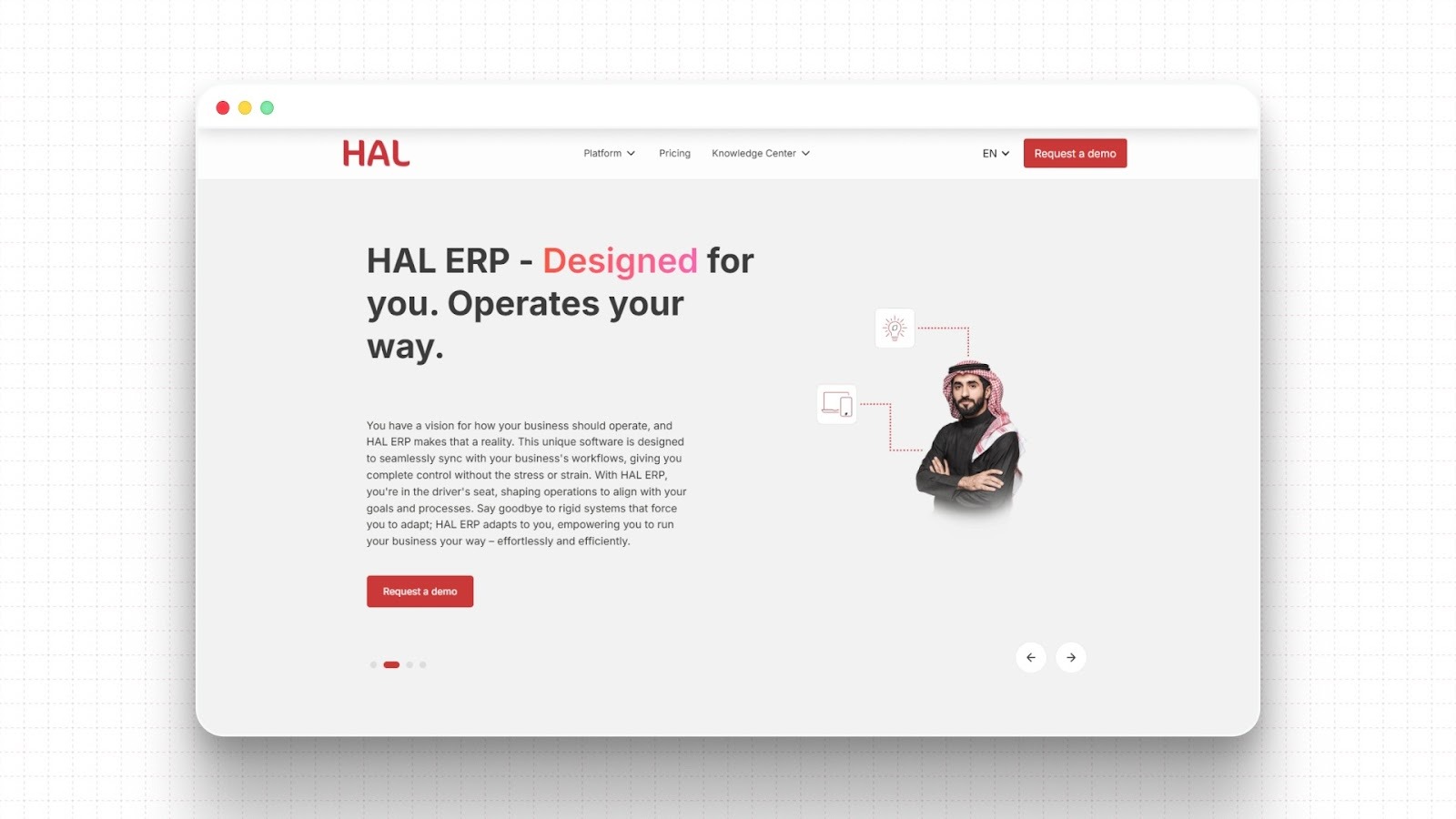
HAL ERP is purpose-built for Saudi businesses. Its Service module is not a bolt-on add-on or a third-party integration. It is a native component of the same platform that manages your finance, HR, inventory, procurement, and project operations.
Here’s what makes it strong for field service in KSA:
Native FSM + ERP Integration: Work orders, service requests, and job completions connect directly to HAL's accounting, inventory, HR, and project management modules, giving finance and operations a single source of truth.
Smart Scheduling and Dispatching: Assign technicians based on skill sets, availability, and location. Automated scheduling reduces manual coordination and eliminates missed appointments.
ZATCA-Compliant E-Invoicing (VAT CARE): Service invoices are generated automatically upon job completion and pushed to the Fatoora portal in real time. No separate compliance tool required.
Bilingual Interface (Arabic + English): Full Arabic-language support for field technicians and back-office staff, with English available for management and reporting layers.
Work Order and Job Card Management: Create, assign, and track job cards, including cost estimates, parts consumed, technician time, and completion status, all from one screen.
Asset and Preventive Maintenance Management: Schedule recurring maintenance cycles, track asset service history, and trigger work orders automatically when maintenance windows are due.
Timesheet-Based Billing and Payroll: Technician hours logged in the field flow directly into both client invoices and payroll calculations, eliminating double entry and reducing billing errors.
SLA Tracking and Escalation Alerts: Set service level agreements per customer contract and receive automated alerts when response or resolution times are at risk.
Mobile Access via ReachApp + WhatsApp Integration: Field technicians can update job status, upload photos, and confirm completions via mobile. Managers receive real-time updates through WhatsApp, a channel already embedded in how Saudi teams communicate.
Multi-Company and Intercompany Support: For holding groups and businesses with multiple subsidiaries, HAL manages intercompany service billing and consolidated reporting from a single platform.
Data Residency in Saudi Arabia: All data is hosted locally on Saudi servers, fully compliant with SAMA regulations and national data residency requirements.
Flexible Pricing: Plans from SAR 1,999/user/year (Gold) to SAR 4,999/user/year (Platinum), with Enterprise plans available on request for larger organizations.
Best For: Mid-to-large Saudi enterprises in contracting, facilities management, manufacturing, trading, or services that need FSM connected to a full ERP, not a standalone tool that creates more data silos.
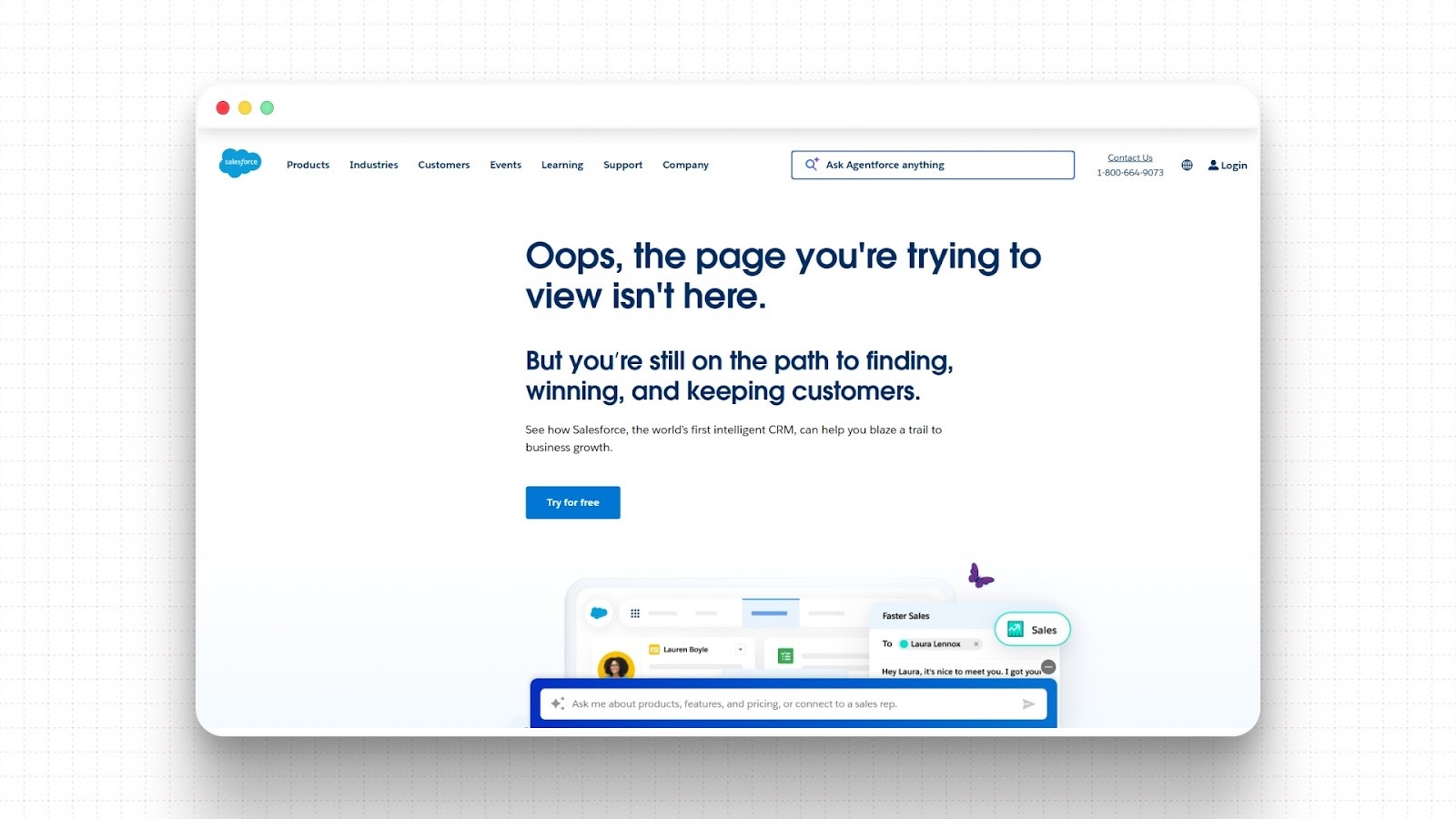
Salesforce Field Service is a powerful enterprise FSM platform, particularly strong for organizations already running Salesforce CRM. Its AI-powered Einstein dispatching engine optimizes technician assignments at scale, and its integration with Salesforce's broader platform gives sales, service, and operations teams a shared customer view.
Key Features:
Einstein AI Dispatching: Predictive scheduling uses AI to assign the right technician based on skills, location, workload, and SLA priority.
CRM-Connected Service: Full visibility into customer history, contracts, and open cases. Service teams see the full account picture before a job begins.
IoT and Connected Assets: For organizations with smart, connected equipment, Salesforce Field Service can trigger work orders automatically based on device alerts.
Mobile-First Technician App: Technicians receive jobs, update status, and capture signatures on mobile.
Analytics and Reporting: Extensive dashboards for service performance, first-time fix rates, and technician utilization.
Limitations for KSA: No native ZATCA e-invoicing support. The Arabic interface is limited. Implementation is complex and typically requires a certified Salesforce partner. Pricing starts at $25/user/month for the most basic tier, but scales significantly for enterprise features. Best suited for organizations that are already deeply invested in the Salesforce ecosystem and have the IT resources to manage a complex implementation.
Best For: Large enterprises with existing Salesforce infrastructure and dedicated IT teams.
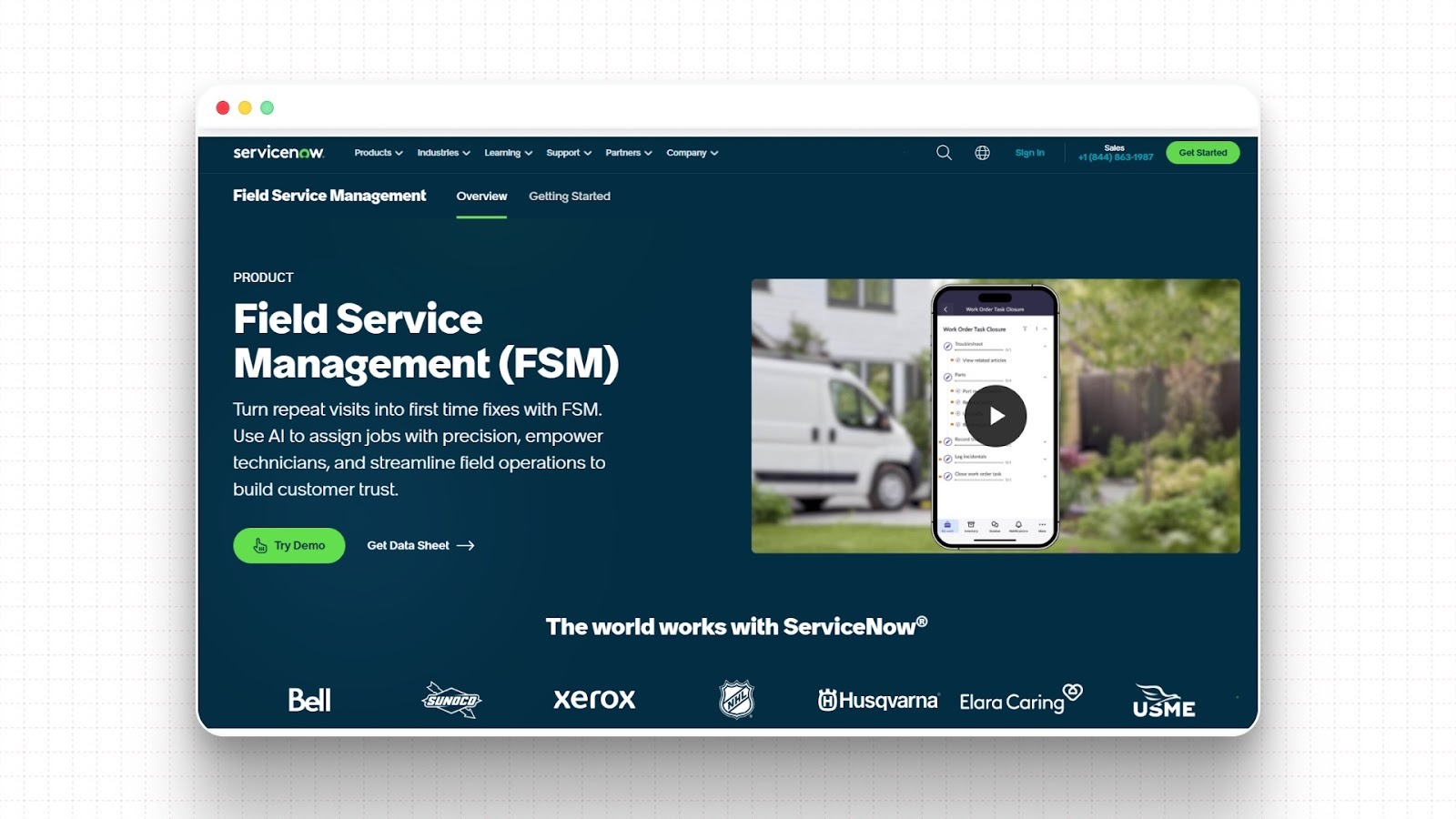
ServiceNow is an enterprise workflow platform that extends into FSM through its Customer Service Management and Field Service Management modules. It is most commonly deployed by large organizations where IT already runs ServiceNow for ITSM, and where unifying IT service management and field service on one platform is the goal.
Key Features:
Unified IT + Field Service Workflows: Connects IT service tickets with physical field dispatch — valuable for organizations where field work is often triggered by IT incidents.
AI-Powered Automation: Workflow automation reduces manual handoffs between teams and systems.
Enterprise-Grade Scalability: Designed for global, multi-site operations with complex approval hierarchies.
Advanced Analytics: Configurable dashboards with detailed SLA and performance tracking.
Limitations for KSA: ServiceNow is priced for large enterprises and requires specialist implementation partners. There is no native Arabic interface or ZATCA compliance built in. Not suitable for businesses under SAR 50M revenue due to cost and implementation complexity. Customization is powerful but requires significant internal IT involvement.
Best For: Large enterprise organizations already running ServiceNow for ITSM that want to extend the platform to field operations.
IFS is a global ERP and FSM provider with deep roots in asset-heavy industries — oil and gas, utilities, defence, and heavy manufacturing. Its Field Service Management module is particularly strong for organizations where the service delivered is tied to the long-term lifecycle management of complex assets.
Key Features:
Asset Lifecycle Management: Tracks the full service history of equipment, from installation through warranty, maintenance, and end-of-life.
Offline Mobile Capability: Technicians can work fully offline in remote or low-connectivity environments and sync when reconnected — highly relevant for industrial sites in KSA.
Scheduling and Optimization Engine: Sophisticated scheduling that accounts for skill, geography, parts availability, and SLA priority simultaneously.
ERP-Connected: IFS FSM is part of a broader ERP platform, meaning parts, financials, and HR are connected natively.
IoT Integration: Supports condition-based maintenance triggers from connected assets.
Limitations for KSA: IFS is positioned at the upper end of the enterprise market with pricing and implementation costs to match. The platform is internationally focused and does not offer native ZATCA compliance or Arabic-language support out of the box. Implementation timelines are typically 6–18 months. Better suited for Saudi Aramco-tier industrial operations than for mid-market contracting or service businesses.
Best For: Large industrial organizations in oil and gas, utilities, or heavy manufacturing where asset lifecycle management is the core requirement.
Zoho FSM is the field service management arm of the Zoho ecosystem, a lightweight, affordable, and relatively easy-to-deploy option for small and growing service businesses. Its strength is its tight integration with other Zoho products, particularly Zoho CRM, Zoho Books, and Zoho Inventory.
Key Features:
Job Scheduling and Dispatch: Drag-and-drop scheduling with technician availability views.
Customer Portal: Clients can log service requests and track job status without calling in.
Time Tracking and Reporting: Technicians log hours from mobile, connected to billing.
Zoho Ecosystem Integration: Works naturally with Zoho CRM and Zoho Books for a connected customer and financial view.
Affordable Entry Point: Free plan available; paid plans from $25/user/month.
Limitations for KSA: Zoho FSM lacks ZATCA-compliant e-invoicing integration within its FSM module. Arabic interface support is basic. No native SLA escalation or asset lifecycle management. For businesses that outgrow the SMB tier, Zoho FSM's feature depth becomes a limitation rather than an advantage.
Best For: Small service businesses in KSA that need basic scheduling, job management, and customer portal features at minimal cost.
Connecteam is not a traditional FSM tool — it is an all-in-one operations platform for deskless, mobile workforces. Its scheduling, task management, and team communication features make it popular with service businesses that have large field teams and need a way to coordinate, communicate, and track work without heavy IT infrastructure.
Key Features:
Scheduling and Dispatching: Visual, drag-and-drop job scheduling with shift management and availability tracking.
GPS Location Tracking: Real-time location tracking for field teams, useful for verifying attendance and monitoring job progress.
Time Clock with Geofencing: Technicians clock in and out from job sites, with geofencing to verify they are on location.
Team Communication: Built-in chat, updates, and knowledge base replace the patchwork of WhatsApp groups and informal communication.
Task Management and Checklists: Digital job sheets and checklists replace paper forms.
Training and Onboarding: Onboard and train field staff directly within the app.
Limitations for KSA: Connecteam is not an ERP and does not connect to finance, inventory, or project management. There is no ZATCA compliance, no asset management, and no SLA tracking. Arabic support is limited. For businesses that need field operations to feed into billing, cost tracking, or project management, Connecteam will require additional tools, which reintroduces the data silos it was meant to solve.
Best For: Service businesses with 20–500 field employees focused primarily on workforce coordination, scheduling, and communication, where financial integration is handled by a separate system.
Simpro is a field service management platform built specifically for trade service businesses, electrical, plumbing, HVAC, fire protection, and similar contractors. Its job costing capabilities are more developed than most FSM tools, making it a reasonable option for contracting businesses that need to track what each job actually earns, not just that it was completed.
Key Features:
End-to-End Job Management: From quoting through scheduling, dispatch, job completion, and invoicing — all within one platform.
Job Costing: Tracks labour, materials, and overhead costs per job in real time, with plan vs. actual variance reporting.
Inventory and Parts Management: Manages stock at the warehouse and van level, with parts consumed on jobs automatically deducted.
Preventive Maintenance Scheduling: Recurring maintenance contracts can be scheduled and dispatched automatically.
Customer Portal: Clients can log requests, review quotes, and sign off on jobs digitally.
Integrations: Connects with accounting platforms like Xero and QuickBooks.
Limitations for KSA: Simpro is built for the Australian and Western markets. There is no Arabic language support, no ZATCA e-invoicing compliance, and no localization for Saudi labour regulations. Pricing is quote-based with a minimum of five users, and modular add-ons increase the total cost meaningfully. For Saudi contracting businesses, the compliance gap alone is a significant barrier.
Best For: English-language trade contractors needing detailed job costing and quoting functionality, particularly those already using Xero or QuickBooks for accounting.
If you are a growing Saudi enterprise managing projects, assets, technicians, and regulatory requirements, an ERP-integrated approach reduces long-term operational friction.
So what exactly changes when you implement FSM software? Let’s look at the core features that make it work.
What Features Does Your FSM Software Must Have?
If you are investing in FSM software, you are not buying a tracking tool. You are restructuring how service requests move from customer call to technician visit to invoice and financial reporting.
Below is what strong FSM software should actually do:
Smart Scheduling and Automated Dispatch: Assign jobs automatically based on technician skills, certifications, availability, and location. Reduce manual coordination and avoid sending the wrong technician to the wrong job.
Mobile Work Order Management (Offline-Capable): Technicians need full job visibility in the field, even without internet access. The mobile app should allow them to view customer history and job details, update task progress, record labor hours, and capture customer signatures. This is critical for remote industrial sites across KSA.
Real-Time GPS Tracking and Route Optimization: Track technician movement and optimize routes to reduce travel time, fuel costs, and missed appointments.
Digital Job Sheets, Checklists, and Photo Capture: Replace paper forms with structured digital workflows. Capture before-and-after photos, signatures, and compliance checklists on-site.
Service Level Agreement (SLA) Management and Alerts: SLA defines response and resolution time commitments to customers. FSM software should track SLA deadlines automatically, trigger alerts before a breach, and escalate high-priority tickets. This protects contracts and prevents penalty charges.
ERP-Integrated Inventory Management: The system must deduct parts from warehouse stock, reflect the cost of the job, and update financial records. Without this integration, inventory mismatches and margin errors increase.
Automated Billing Linked to Work Orders: Generate invoices once a job is completed. Include labor hours and parts automatically. Finally, push data directly to finance systems. This shortens billing cycles and improves cash flow.
Technician Performance Dashboards: Must monitor metrics like First-Time Fix Rate, response time, and technician utilization. Make data-driven staffing and training decisions. These metrics help identify training gaps and staffing issues.
Customer Portal for Service Requests: Allow customers to log service requests, track job status, and view service history without constant phone calls. This reduces administrative workload and improves transparency.
Preventive Maintenance Scheduling: Automate recurring service visits based on asset lifecycle, warranty terms, or maintenance contracts. Shift from reactive to preventive service. Preventive service reduces emergency breakdowns and improves long-term customer retention.
Arabic Interface and Bilingual Work Orders: Support Arabic-language interfaces and bilingual documentation for field teams and customers across Saudi Arabia. This improves technician adoption and customer communication.
ZATCA-Compliant E-Invoicing: Invoices must comply with regulations set by the Zakat, Tax and Customs Authority (ZATCA). FSM software integrated with your Enterprise Resource Planning (ERP) system should generate compliant electronic invoices, include required QR codes and tax details, and store invoice records as mandated.
Value Added Tax (VAT) Handling: The system must apply the correct Value Added Tax (VAT) rates on labor, contracts, and parts, reducing compliance risk.
When these features work together inside a connected system, field service stops being reactive and disconnected. It becomes measurable, financially controlled, and compliant.
Conclusion
When you choose the best field service management software, you gain control over scheduling, inventory, billing, compliance, and project profitability in one connected system.
For Saudi businesses in contracting, manufacturing, trading, and servicing, disconnected processes lead to delayed invoicing, inventory errors, and unclear margins.
An ERP-integrated Field Service Management (FSM) solution eliminates these gaps and gives decision-makers real-time visibility across operations. If you are planning to modernize your field operations in 2026, HAL is here for you.
Book a demo with HAL today and see how HAL ERP can streamline your field service operations from job completion to compliant invoicing.
FAQs
Q: What is the best field service management software for small businesses?
For small service businesses in KSA, Connecteam or Zoho FSM offer affordable entry points. However, businesses planning to scale should consider a system like HAL ERP that can grow with them without needing to switch platforms.
Q: What is the difference between FSM software and ERP software?
FSM software manages field operations, scheduling, dispatch, work orders, and SLAs. ERP software manages the whole business, finance, HR, procurement, and operations. The best approach for growing enterprises is an ERP with native FSM capabilities, so field data and financial data live in one system.
Q: Does FSM software work in Arabic?
Not all FSM tools support Arabic interfaces or right-to-left (RTL) text. For Saudi businesses, choosing a system with a native bilingual interface is essential for technician adoption and operational compliance.
Q: Can FSM software integrate with ZATCA e-invoicing?
Yes, but only if the platform supports Saudi Arabia's e-invoicing requirements. HAL ERP includes built-in ZATCA-compliant invoicing that triggers automatically upon work order completion.
Mohammed Ali Khan
Mohammed Ali Khan is a seasoned ERP Implementation Consultant with over 100 successful projects across Saudi Arabia. With expertise across diverse industries, he has spearheaded large-scale retail implementations for hundreds of stores, bringing deep knowledge of omnichannel commerce, payment integrations, and the unique challenges of retail operations in KSA.